Get email alerts on the Hazardous Waste Fees topic
No spam. Unsubscribe anytime.
District committee backs introducing fee changes to cover costly lithium‑ion and foam‑insulation disposal
Summary
The Monroe County Waste Reduction District executive committee voted to forward a resolution to amend fees so residents bear the lesser of 50% of district disposal costs or $500 for large/DDR lithium‑ion batteries and certain spray‑foam canisters, after staff warned disposal expenses are rising sharply.
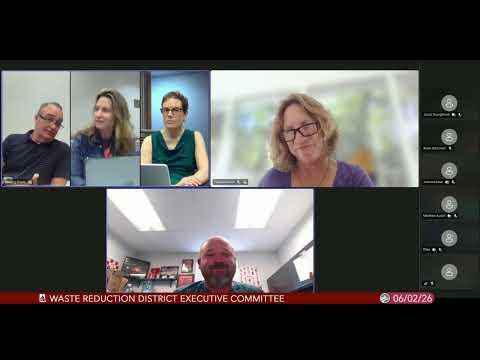
The Monroe County Waste Reduction District executive committee on Tuesday agreed to send a proposed amendment to the district fee schedule to the full board to address soaring disposal costs for large lithium‑ion batteries and do‑it‑yourself spray‑foam insulation canisters. The measure (Resolution 2026) would require residents to pay the lesser of 50% of the district’s disposal cost or $500 for specified household hazardous items outside traditional residential waste.
The change targets several categories staff said are driving costs: lithium‑ion batteries above the residential watt‑hour threshold (staff cited 300 watt‑hours as the residential cutoff), damaged/defective/recalled (DDR) lithium‑ion batteries, vehicle and rooftop solar backup batteries, and non‑aerosol foam‑insulation canisters treated by vendors as compressed cylinders. Joey Long, a district staff member who presented the packet, said, “Those Prius batteries are going to cost about two grand a piece,” and noted damaged batteries and special packaging raise costs sharply.
Why it matters: Vendors have limited capacity to accept large or damaged lithium‑ion batteries and require protective packaging and special shipping for DDR batteries. Staff described five‑gallon buckets that cost the district to acquire and use for shipping DDR batteries and said the district currently pays roughly $200 per five‑gallon bucket (capacity: 11 pounds) and about $1,550 for a 55‑gallon drum option. Those costs, combined with increased volumes of rechargeable devices and larger batteries in tools, e‑mowers and some e‑bikes, are pressuring the district’s budget.
What was proposed: The draft fee language would add specific charges under the district’s household hazardous waste category and a corresponding call for pricing under the commercial/conditionally exempt small quantity generator (CESQG) list. The packet proposed applying a price cap to resident charges — the lesser of 50% of district cost or $500 — while commercial entities would be charged full price. Staff noted an errant watt‑hour number in a pricing table and said the threshold should be corrected to 300 Wh.
Discussion and next steps: Committee members asked whether insurance might cover some costs when batteries arrive from vehicle accidents; staff said those incidents are handled case‑by‑case and sometimes involve first responders bringing burned batteries to the district for safe storage. Staff also flagged pending state legislation on extended producer responsibility that, if enacted, could create a manufacturer‑funded program to offset collection and disposal costs. The committee agreed to forward the resolution to the full board for introduction; by statute the resolution must be introduced at one meeting and then wait at least two weeks before a public hearing and a vote.
The board packet will include the corrected watt‑hour threshold and the vendor price calls; staff said they expect to revisit the fee language as battery types and legislation evolve.
AI generated
The text on this page is AI generated. Summaries, highlights, analysis, and video transcripts are all produced from the original source material.
AI can make mistakes, so if you spot one, and we will fix it for everyone.
Note: the source content is unaltered by us. Any content source we link to, be it a video, an audio recording, or a document, is presented exactly as its publisher released it. That publisher is usually a government body, sometimes an individual official or another organisation.