Get Full Government Meeting Transcripts, Videos, & Alerts Forever!
Get email alerts on the Land Use topic
No spam. Unsubscribe anytime.
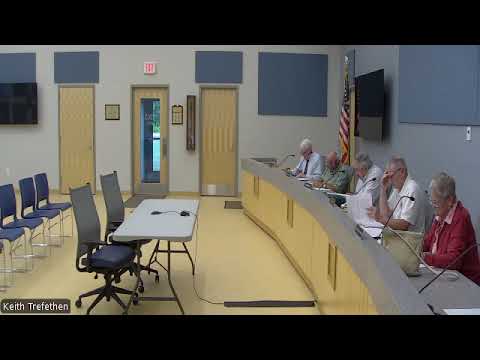
Select Board to probe 1995 consent agreement after resident offers cul-de-sac and public-safety upgrades
Summary
Michael Thomas told the Arundel Select Board he will survey and offer to sign over a cul-de-sac and adjacent land, proposing an eyebrow road and $70,000–$80,000 for a cistern; the board voted to investigate what is needed to complete the 1995 consent agreement before Mr. Thomas proceeds with subdivision work.
Michael Thomas, a Clear View property owner, told the Arundel Select Board on July 14 that he wants to resolve a decades-old encroachment by formally conveying the cul-de-sac area that sits on his land to the town and to enable limited development off the existing road.
“I would like to propose that I sign over the culdeac with the consent decree… I would have it surveyed out, sign over the portion of the land that’s mine to the town,” Thomas said, adding he would build an eyebrow road rather than a hammerhead and pay to extend a short public road to an abutting parcel. He said he plans to build about 10–15 houses on roughly seven acres of his 27-acre parcel and offered to contribute $70,000–$80,000 to install a cistern or other public-safety water source for the neighborhood.
The proposal matters because a 1995 consent agreement arises from an earlier subdivision irregularity: the town and developers previously negotiated an agreement to tolerate a mislocated road rather than require immediate reconfiguration. Thomas said remedying that nonconformance would allow him, the planning board and neighbors to move forward without lingering deed or survey uncertainty.
Board members emphasized the limits of the select board’s authority. Several members noted the select board can accept donated land and contract to build a road across donated land, but planning-board approvals are required for subdivision changes such as new roads or adding a cistern. Select Board members asked that any acceptance or town action be conditional on planning-board approval and legal review to avoid committing the town to a road it must later maintain.
Select Board Chair Dan moved that staff investigate what is necessary to complete the 1995 consent agreement — verify whether a survey and deed descriptions already exist and, if not, identify survey and legal costs and steps required to finalize the consent agreement. The motion passed after a second. The board directed staff to return with documentation, a cost estimate and a proposed path forward so Thomas can decide whether to pursue planning-board approvals.
Thomas said he had been coordinating with the town attorney and did not want to spend time and money on engineering and surveys until he had an indication the town would support resolving the consent agreement. He described the proposed cistern and walking trails as proffers intended to provide public benefit and to reduce public-safety risk in the neighborhood.
Next steps: staff will research existing records and surveys, estimate survey and legal costs, and present options and budget implications to the select board for a follow-up decision. The planning board retains authority over subdivision amendments or approvals for new infrastructure such as cisterns.