Get Full Government Meeting Transcripts, Videos, & Alerts Forever!
Get email alerts on the Drought topic
No spam. Unsubscribe anytime.
State DEQ warns Rappahannock County of drought conditions similar to 2001–02; groundwater and private wells at risk
Summary
A Virginia Department of Environmental Quality planner told the Board of Supervisors that much of the state is in D2/D3 drought conditions and that local groundwater wells are recording provisional record lows; DEQ recommended public awareness, contingency planning and that the county coordinate on a regional water-supply plan.
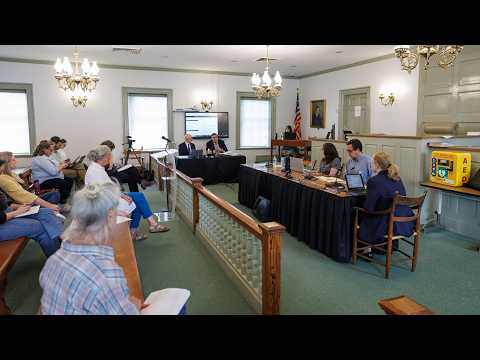
Andrew Noise, a water supply planner with the Virginia Department of Environmental Quality, told the Rappahannock County Board of Supervisors on June 1 that much of Virginia is showing D2/D3 drought conditions and that several indicators — including stream flows and private-well levels — are near historical lows.
Noise said the state evaluates drought using multiple measures — meteorological, agricultural, hydrological and water-supply — and assigns advisory statuses across 13 drought-evaluation regions. "We have some of the most extensive D2 coverage for May in the state," he said, adding that the maps show areas of D3 coverage reminiscent of the 2001–02 drought.
Noise highlighted that many county residents rely on private wells and that a number of long-term groundwater monitoring wells around the region are reporting provisional record lows. He said reservoir assessments use days-of-storage metrics while well and stream indicators are evaluated against historical percentiles.
Board members and residents asked about practical steps the county could take and whether the county’s 2011 water-supply plan — which Noise said is being updated with a target of 2029 — could be expedited. Noise said the water-supply plan is prepared regionally and can be completed sooner than the due date if local stakeholders move to accelerate the work.
On funding and local responses, Noise said the state’s drought monitoring task force meets weekly to evaluate conditions and that tools such as the DEQ drought dashboard and weekly infographics are available for local officials and the public. He also described how high-volume water-withdrawal permits are evaluated using historic worst-case drought simulations to protect instream flows.
During public questions, residents raised concerns about water use by potential data centers, grants for fencing to keep livestock out of streams, and whether rainwater harvesting or cloud-seeding were used locally. Noise said the state does not use cloud seeding in drought management and emphasized the importance of public conservation messaging and contingency plans for wells that may run dry.
The board did not take formal action but requested continued contact with DEQ and resources that the county can share with residents.
The presentation and subsequent public Q&A ran from the DEQ briefing through a series of resident and supervisor questions on specific local impacts and funding for planning.