Get Full Government Meeting Transcripts, Videos, & Alerts Forever!
Get email alerts on the County Budget topic
No spam. Unsubscribe anytime.
Hennepin County warns of staffing shortfalls and $59M federal revenue exposure as it shapes the 2027 budget
Summary
County finance staff reported year‑over‑year declines in staff hours and flagged anticipated federal cuts — a $20M SNAP administrative loss, $12M potential HUD change and a $27M Medicaid exposure — while urging hiring management, contract reviews and hospital planning as mitigation steps.
Hennepin County officials told the Administration, Operations and Budget Committee on June 2 that the county faces “substantial budget challenges” through 2026 and into 2027 and outlined multiple federal revenue risks that could require local offsets.
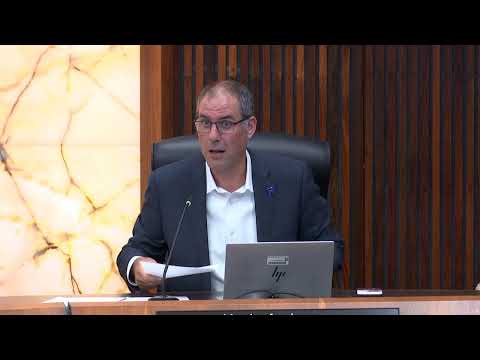
Chief Financial Officer Joe Matthews told commissioners this presentation was the administration’s third update of the year and emphasized a mix of workforce and federal revenue pressures. “This is our third update of the year and in today’s presentation, you’ll hear about our progress from January through April,” Matthews said at the opening of his slide deck.
The county reported fewer employees on the payroll compared with last year. Matthews described three staffing metrics — budgeted FTEs, hired FTEs and actual paid hours — and said the county had roughly 225 fewer hired FTEs and about 432 fewer actual FTEs on payroll compared with the prior year. He noted Minnesota’s new paid family leave accounted for some of the difference in paid hours but did not fully explain the drop.
Matthews told the committee that while 2026 spending remains under the county’s annual budget so far, March and April spending rose relative to 2025, driven largely by non‑property tax areas such as enrollment and claims at Hennepin Health.
On federal funding, Matthews identified three major headwinds that together could represent roughly $59 million in reduced federal revenues for services the county administers: $8 million already enacted in SNAP administrative revenue reductions, an additional $20 million in anticipated SNAP administrative revenue losses, $12 million of concern related to HUD housing security funding adjustments, and a preliminary $27 million estimate of potential Medicaid impacts to county clinics. He emphasized the Medicaid estimate is fluid: “That third number is obviously going to be very much in flux,” Matthews said, pointing to ongoing state and federal actions and payment deferrals.
Commissioners pressed staff on how staffing figures map to financial impact, the multiplier effect of overtime, and whether the state will backfill lost federal revenue. Administration said some state mitigation money was appropriated but acknowledged it would not cover the full losses and that the county’s ability to backfill is limited. On SNAP specifically, staff described the $8 million already enacted as distinct from the $20 million additional administrative revenue reduction anticipated in 2027; both affect county budgets differently because the administrative dollars fund county work to deliver benefits.
County leaders described several mitigation strategies: tighter hiring management prioritizing critical services, review of contracts and capital projects, and additional planning tied to Hennepin Healthcare operations to understand potential capital and operational exposures. Matthews and other administrators scheduled follow‑up briefings — including a June 11 board briefing and a July 28 committee update — to provide more detail ahead of the 2027 budget process.
What happens next: staff said they will continue to monitor federal actions and work with state associations and the legislature on potential mitigation. Commissioners asked for more granular data by department on vacancy factors, overtime cost impacts and the county’s exposures if providers that receive Medicaid reimbursement lose payments.
Ending: administration urged continued transparency with residents and pledged further data in the coming briefings as the county prepares for a tighter 2027 budget.