Get Full Government Meeting Transcripts, Videos, & Alerts Forever!
Get email alerts on the Ordinance Amendment topic
No spam. Unsubscribe anytime.
Commission discusses master-plan outreach, sustainability fair and Article 10 edits including climate language and planting-plan requirements
Summary
Planning staff updated the Portsmouth Conservation Commission on outreach: a master-plan open house on April 22 and a sustainability fair on April 10. The commission continued edits to Article 10 of the wetland ordinance — adding climate-resiliency language to the purpose statement, requiring planting plans and LID measures in applications, tightening tree-removal rules and proposing higher fees for after-the-fact permits.
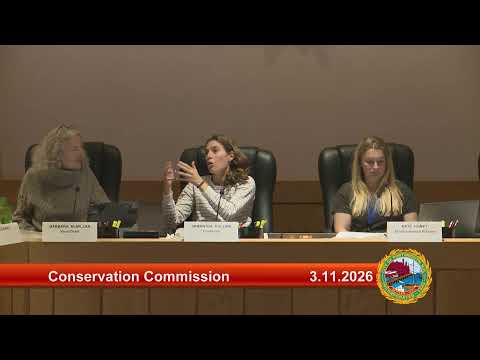
Planning staff briefed the Portsmouth Conservation Commission on upcoming outreach and continued detailed edits to Article 10 of the city's wetlands ordinance at the March 2026 meeting.
Staff said the city will hold a master-plan open house on April 22 to present goals and strategies, and offered the conservation commission a table at a sustainability fair on April 10 to do outreach on wetland buffers and the commission's work. Staff introduced Sabrina Allen, an intern from the University of New Hampshire assisting on a citywide heat-resilience study; Allen will help survey residents and community groups about heat vulnerability and resources.
On Article 10 edits, staff presented a set of proposed language changes and clarifications. The commission favored adding a new phrase to the ordinance purpose statement "to assist in protecting and improving the future of Portsmouth's resiliency with regard to climate change impacts and maintaining carbon neutrality," to encourage applicants and reviewers to consider climate resilience. Commissioners also reviewed a set of definitional clarifications (for example, describing a vegetated "no-cut" buffer and explicitly listing "ground disturbance") and discussed operational changes including:
• Requiring a planting plan that shows existing vegetation to remain and proposed plantings (species, size at planting, and locations) for projects that remove vegetation; staff and commissioners debated how strict the requirement should be for very small projects.
• Asking for descriptions or locations of low-impact development measures and best management practices where applicable (e.g., crushed stone beneath a stair or specific erosion controls for trail work).
• Expanding permitted uses language in a few places (for example, in-kind improvements to existing public rights-of-way) and clarifying emergency-generator pad allowances so homeowners using prefab pads will not need to file for small variances.
• Adding a permitted exception to remove "high-risk" trees in the no-cut buffer when supported by a certified arborist's risk assessment and clarifying that stumps/roots should remain in place if tree removal is approved.
• Proposing an enforcement path that accounts for work done without a permit; staff said the fee committee is considering a higher fee for after-the-fact permits (roughly double the normal fee) and the commission discussed specifying that penalties or holds may apply to pending permits for applicants with open violations.
Commissioners spent time line-editing the draft and agreed to send the revised text to the city's legal department for review before returning to the planning board for coordination. Several commissioners said that adding climate-resiliency language is important even if the ordinance does not yet include detailed standards.
Next steps: staff will solicit legal review on the draft changes, bring back any edits suggested by legal, and return the ordinance revisions and outreach plans to the commission in April for further action.