Get Full Government Meeting Transcripts, Videos, & Alerts Forever!
Get email alerts on the Land Use Data Centers topic
No spam. Unsubscribe anytime.
Stephens County work session draws heavy public opposition to proposed data-center rules; commissioners weigh strict limits
Summary
Residents at a Stephens County work session urged strict limits or an outright ban on data centers over concerns about water use, noise, environmental harm and limited local jobs; county staff outlined a draft ordinance with setbacks, monitoring and cooling requirements while commissioners debated legal risks of a ban.
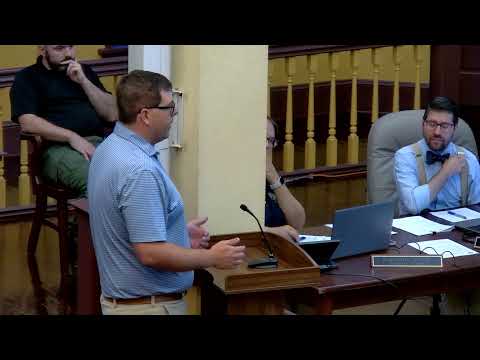
Stephens County commissioners held a public work session to review a draft ordinance regulating data centers and to solicit public comment, drawing a crowded room and repeated calls from residents to block or tightly limit developments that, they said, would strain local water supplies and harm rural character.
County staff summarized the draft ordinance and an existing moratorium. Mr. Hamilton, a county staff member, said the draft adds a definition of 'data center,' treats such facilities as a conditional use in the commercial/industrial zoning district, and includes site rules such as a minimum lot size (10 acres), an allowance limited to the Haystone Brady Business Park, perimeter fencing with vegetative screening, and minimum setbacks from residences and roads. He summarized utility requirements including mandatory power, water and broadband impact studies, a preference for air-cooled or hybrid cooling with water reclamation and reuse, monthly reporting of water withdrawals and wastewater discharge, and noise limits set at 60 dBA daytime and 50 dBA nighttime at the property line.
"We have not had an application for a data center," Chairman Rickman told the meeting as he opened public comment, stressing the work session’s intent is feedback on the ordinance draft rather than review of a specific proposal. Staff also noted the county's moratorium on data-center applications has been extended through mid‑October 2026 while rules are refined.
Public commenters voiced near-uniform skepticism or opposition. Lauren Thomas, a resident who said she works for a large tech company, urged the county to study whether tax breaks actually benefit Stephens County and to be patient rather than serving as an early test case.
"I am well versed in the idea of a data center and why it would be used," Thomas said, and she urged commissioners to check whether promised jobs and tax gains materialize in other counties.
Other speakers raised water as their primary concern. Billy Chisholm, a long-time resident, summarized municipal treatment capacity for Toccoa and warned that the city currently treats about 5 million gallons per day and is operating near that limit. "Water is life. Data centers are not life," Chisholm said, urging the county to treat available treatment and distribution capacity as a binding constraint in ordinance language.
Multiple residents described local wells that have suffered low yield or contamination and argued that large data-center cooling systems could further stress or contaminate groundwater. Several commenters asked the county to prohibit connections to public water for large cooling uses or to require municipal reuse systems and binding utility agreements so that costs and infrastructure upgrades are not shifted to other users.
Speakers also pressed commissioners on jobs and economic tradeoffs. Several residents noted that modern data centers typically bring few permanent on-site jobs—one speaker cited "about six employees"—and questioned whether long-term tax revenues offset infrastructure costs or temporary incentives.
Environmental and ecological concerns were raised by Casey Quarterman, a U.S. Forest Service manager, who described local endemic species and the contribution of nearby wilderness areas to the Tugaloo River watershed; he urged protecting the county's natural assets rather than courting potentially disruptive development.
Health and nuisance issues were repeatedly cited: noise from backup generators and cooling systems; nighttime lighting and infrared visibility; and worries—some anecdotal or unverified—about chemical discharges and broader health effects. Speakers requested strict noise and lighting limits, temperature limits for thermal discharges, frequent reporting and mandatory fines for violations.
Several commenters proposed policy approaches to deter unwanted projects: raising minimum site-area thresholds well above the current 10-acre draft (residents suggested 150–225 acres or tying allowable acreage to the county’s industrial park), placing facilities only on major arterial roads, requiring robust landscape buffers and multiple rows of screening, and requiring substantial upfront investments in alternative cooling and power sources so that only applicants prepared to incur high costs would apply. One speaker with prior data‑center construction experience said requiring specific, costly materials for subcontracted landscape and construction work can materially raise project costs and discourage applications.
Speakers also urged the county to guard against non-disclosure agreements that can limit public oversight; several warned that some developers use temporary 'non-road' engines (gas turbines on trailers) or other technical workarounds to evade standard permits, and asked staff to close known loopholes.
Commissioners discussed legal strategy. Some speakers urged an outright ban, pointing to counties that have pursued prohibitions; county officials and staff cautioned that an absolute ban risks constitutional challenge and recommended instead drafting a legally durable ordinance with strict, defensible standards that would make the county unattractive to large developers. Commissioner Wright and other staff referenced Gilmer County as a precedent and said the county's attorneys are reviewing options and the Gilmer ordinance language.
The only formal action at the meeting was routine: the board approved the meeting agenda by motion at the start of the session. No votes were taken on the ordinance itself; commissioners left the draft open for further revision.
What’s next: staff and county attorneys will continue to revise the ordinance language, factoring public input on water limits, setbacks, cooling technologies, monitoring and enforcement. Commissioners encouraged continued public engagement and additional review of comparative ordinances and legal precedents before returning the draft for further readings or formal action.
The work session closed after more than two hours of testimony; with no ordinance decision taken, the county's moratorium remains in place while staff finalizes recommended language for the board and its attorneys to review.