Get Full Government Meeting Transcripts, Videos, & Alerts Forever!
Get email alerts on the Master Plan topic
No spam. Unsubscribe anytime.
Consultants present draft Portsmouth master plan focused on housing, small business support and neighborhood centers
Summary
Consultant UTIL presented a draft master plan to the Portsmouth Economic Development Commission that emphasizes a 10-year strategic vision linking housing, economy, mobility and land use, highlights 'gateway' neighborhood centers outside downtown, and requests commissioner feedback ahead of an April 22 public open house.
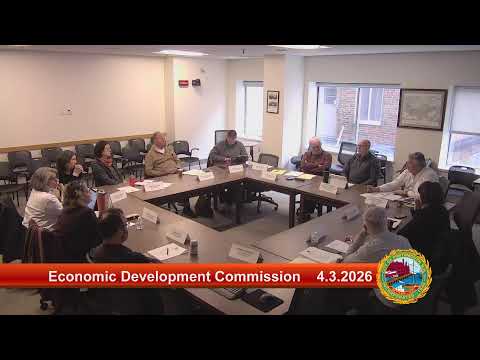
Consultant project manager Zoe Mueller of UTIL presented the draft Portsmouth master plan to the Economic Development Commission on April 3, describing it as a 10-year strategic guide that links housing, the local economy, transportation and land use.
"Portsmouth will continue to cultivate our role as the seacoast region's cultural and economic hub, protect the places that anchor our shared identity and historic character, and invest in sustainability and resilience," Mueller said, reading the draft vision statement and asking the commission to review draft recommendations scheduled to be circulated April 17.
Mueller said the draft recommendations are locked in for review and that the city is in a stakeholder-validation phase ahead of a public open house on April 22 at the Community Campus. She described outreach tools used so far—an initial representative 'flash vote,' a public survey and a targeted short survey for small businesses and hospitality workers—and asked commissioners to help amplify the business survey.
The draft plan centers on four linked topics—housing, economy, transportation and urban form—and folds crosscutting themes (vibrancy, inclusivity, connectivity, sustainability and resiliency) into recommendations. A spatial framework presented by UTIL maps places for preservation, targeted enhancement and more significant adaptation. Mueller emphasized reinforcing downtown while deliberately cultivating neighborhood 'gateway' centers outside downtown to help distribute economic activity and ease price pressure in the urban core.
On economic recommendations, Mueller outlined three objectives: strengthening small and local businesses, maximizing benefits from tourism and hospitality while preserving accessibility for residents, and attracting anchor employers and innovation-sector growth. She said targeted zoning refinements—particularly within the gateway neighborhood mixed‑use districts adopted in 2017—could include incentives and design guidelines to promote affordable housing and affordable commercial space.
Commissioners and chamber representatives pressed on implementation and messaging. One commissioner asked if the plan has recommendations for post-draft communications and developer outreach; Mueller recommended a multi-channel approach (prominent website placement, communications networks, short flyers) and encouraged pre-application meetings so developers learn city expectations before investing in full proposals.
Commissioners raised concerns about affordability and small‑business displacement as downtown rents and consolidation increase. Mueller and commissioners flagged incubator or shared-space concepts—using underutilized public or institutional properties and creative funding—to lower barriers for small or customer-facing businesses; Mueller said language on incubators and non‑storefront digital/service firms could be clarified in recommendations.
Commissioners also discussed workforce and education links to the plan, citing local training infrastructure (a CTE center, Gray Bay Community College and other programs) and noting that master plans can indicate where training facilities and education partners should be located without specifying curriculum or operational details.
Mueller asked the commission to review the draft recommendations when distributed on April 17 and to attend or promote the April 22 public open house from 6 to 8 p.m. at the Community Campus. The draft remains in stakeholder review and will be revised following the open house and additional feedback.
The commission did not take formal policy votes on the plan at the meeting; the item was presented for feedback and outreach planning.