Get Full Government Meeting Transcripts, Videos, & Alerts Forever!
Get email alerts on the Municipal Budgeting topic
No spam. Unsubscribe anytime.
Citizen budget subcommittee urges conservative sales‑tax baseline, larger transparency measures and several cost‑cutting pilots
Summary
A citizen budget subcommittee presented a package of recommendations including using last year’s sales‑tax receipts as a conservative baseline (with excess routed to capital), improved budget transparency for grant line items, motorpool and fleet savings, and pilot revenue ideas for parks and the amphitheater.
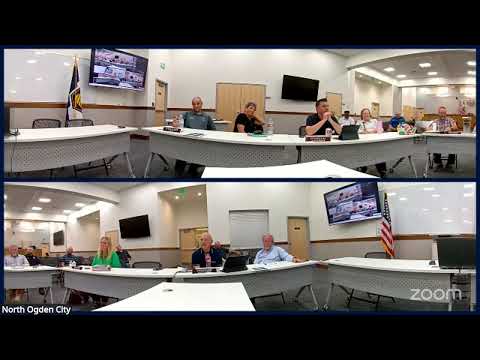
The North Ogden City Council heard a wide‑ranging report from its citizen budget subcommittee on proposals to tighten budgeting practices, identify savings and pilot low‑risk revenue ideas.
The subcommittee recommended using last year’s actual sales tax receipts as a baseline for the next year’s budget and placing any overage into capital projects rather than relying on optimistic forecasts. Subcommittee members and several councilors suggested alternatives such as a rolling 12‑month average or a three‑year median for the most recent months to reduce guesswork in forecasting; staff noted that official actuals are typically known later in the summer and that any method will involve tradeoffs.
On transparency, the group urged clearer labeling on the budget’s “yellow sheets” so that grant‑funded expenses explicitly show the offsetting revenue and do not appear as new net costs. The committee also encouraged public communications that highlight staff and departmental cost‑saving efforts — for example, in‑house work that saved the city an estimated $150,000–$200,000 on a public works drainage project.
Finance director Peter reported an in‑depth motorpool review that identified $200,000–$300,000 in potential savings after aligning internal charges to depreciation and cleaning up fund accounting. He said the motorpool fund still retains adequate reserves for vehicle replacement.
The committee proposed a set of modest revenue and cost‑management pilots: consolidating Comcast/data contracts across city buildings for volume discounts; testing food‑truck permitting at busy park tournament days; a banner sponsorship program for the amphitheater and pool (staff were asked to implement a simple pilot, with a target of August 1 for an initial rollout); and exploring naming or endowment opportunities to make city venues more self‑sustaining.
On service contracts and facilities, the group recommended early planning for two potentially expensive transitions: the county animal‑shelter agreement that expires in roughly two years, and the county’s stated intent to step away from the regional senior center. Committee members urged evaluating regional partnerships, in‑house options, or new funding models sooner rather than later to avoid last‑minute decisions.
The pool and parks drew particular attention. The committee urged that the aquatic center’s operating model account for depreciation so replacement funds are accumulated, recommended exploring expanded concessions and Sunday openings (a season‑long pilot was suggested) to increase revenue, and warned that large fee jumps risk pricing out typical users. For parks, the group recommended periodic fee benchmarking with neighboring cities, prioritizing replacement funds for playgrounds (estimated around $150,000 per major replacement) and considering whether some pocket parks in private developments should remain the developer/HOA responsibility.
Several council members praised the subcommittee’s breadth and asked staff to return with implementation details and monetary estimates for the highest‑value recommendations. No formal council actions or votes were recorded during the work session; multiple items were referred to staff for follow up.
The subcommittee said the intent of its package is not only to find one‑time savings but to build clearer, more conservative budgeting practices, improve public understanding of where tax dollars go, and create small, testable pilots that could reduce the need for larger revenue increases.