Get Full Government Meeting Transcripts, Videos, & Alerts Forever!
Get email alerts on the Student Records Management topic
No spam. Unsubscribe anytime.
Prince George’s County school officials outline records-management practices, digitization plans after Hyattsville incident
Summary
School officials described how student records are prepared, secured, audited and moved between schools, outlined a pilot to digitize files and said a records breach tied to a Hyattsville move occurred during physical transfer; officials also addressed parent access procedures, cybersecurity vetting and staffing challenges.
Prince George’s County Board of Education audit committee members heard detailed briefings June 1 from student-records staff on how the district stores, secures and moves student files, the planned expansion of a digitization pilot and the circumstances of a records exposure amid a Hyattsville school demolition.
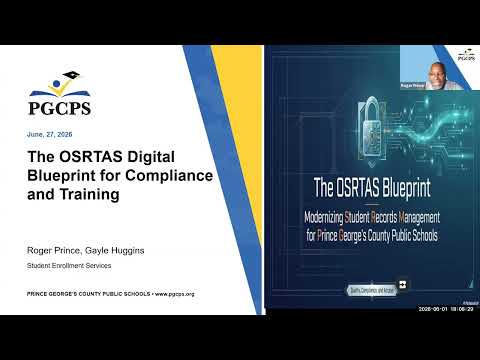
Dr. Tiffany Anderfol, District One board member and committee chair, opened the meeting and said the committee requested the review after parent concerns were raised about records during a school demolition. Roger Prince, director of student enrollment services for Prince George’s County Public Schools, and Gail Huggin, supervisor of student enrollment services, led the presentation.
Prince summarized the office that handles pupil accounting, school boundaries and student records, saying the work rests on two pillars: compliance and training, and a phased move to digital records. "We immediately begin engaging the school-based management records team," Prince said, describing on-site coordination when schools are relocated or closed.
Huggin described the records office team and training regime. She said the office issues more than "over 15,000 diplomas and certificates" annually, conducts on-site technical visits, audits records for completeness before transfers and maintains archival copies dating back to 1923 in a cloud environment. She told the committee the office consolidated legacy formats (tape, microfilm) beginning in 2015 and automated workflows to improve retrieval.
On the Hyattsville exposure, Prince said the district had wrapped and sealed records during a multi-day move but that "I believe that is when a breach occurred" while movers were transferring materials amid demolition and asbestos abatement. He said the building was a construction site, that non‑authorized community members were not supposed to be present, and that certified district officials and vetted workers were responsible for moving and securing records.
Exchange — transitional records: Board member Pamela Boozer Strruther asked how student folders move between grade bands. Huggin described a January-to-summer process: schools identify feeder patterns, complete a "prek–12 transitional record review" checklist that documents each item in a folder, box records for pickup on a scheduled route, and complete compliance reviews at the receiving school with multiple staff signatures.
Exchange — transfers out of county and fees: Board member Jackson Saunders raised a case in which parents of a special-education student said they were charged and waited 25 business days for records that were still incomplete. Huggin replied that parents should first receive a withdrawal packet at the sending school (birth certificate, immunizations, last report card and copies of IEP/504 where applicable) and that official record requests are submitted through the district’s secure portal. "If a student is currently enrolled there is no cost to the parent," Huggin said; she added that receiving schools create verified user profiles to request full electronic records and that the system maintains an audit trail. The presenters said they also publish instructions on the Office of Student Records, Transfer and Archival Services website.
Cybersecurity and vendor vetting: Committee members pressed about cyberattacks and vendor security. Presenters said the district uses a longstanding document‑management vendor (separate from the Synergy/Edupoint student information system) that was vetted by internal audit and IT. Prince said the district has "never since 2015 had any breaches, not one since 2015" in its document-management system.
Access controls: Staff explained access is tiered: district email and HR vetting are required, staff must be trained and authorized for specific data fields, remote access requires VPN and multiple layers of authorization, and schools upload scanned images to the secure portal with timestamps so the office can trace what was requested and sent.
Recurring operational challenges: Presenters identified high turnover and low pay among school secretaries and registrars as a persistent problem that forces repeated retraining and can degrade consistency. To address this the office has expanded in‑person training, maintains a daily chat help line for registrars and uses audits (including SurveyMonkey tools) to surface compliance gaps.
What happens next: The committee received the briefing and asked follow-up questions; staff said further work on a districtwide governance plan, a feasibility study, resourcing and a project team will be required to scale digitization. Chair Anderfol closed the meeting, noted the next committee meeting on Sept. 1, 2026, and adjourned at 7:07 p.m.
Exchange list (high‑level): - Dr. Tiffany Anderfol (chair) opened the meeting and framed the review. - Roger Prince (director) explained office structure, Hyattsville circumstances and vendor history. - Gail Huggin (supervisor) explained day‑to‑day records practices, transitional checklists and parent access procedures. - Jackson Saunders (board member) questioned incomplete transfers for a special‑education student; Huggin described portal and audit‑trail processes.
The presentation supplied operational detail about how records are inventoried, moved and audited, and it flagged three outstanding areas the board may press further: (1) the Hyattsville exposure and whether procedures need additional safeguards during moves, (2) the districtwide governance, funding and timeline to scale digitization, and (3) workforce stability for registrars whose turnover complicates consistent compliance.
The article draws only on statements made during the June 1 audit committee meeting and avoids inference beyond those remarks. The district’s Office of Student Records, Transfer and Archival Services and the presenters supplied numeric examples and process descriptions during Q&A.