Get Full Government Meeting Transcripts, Videos, & Alerts Forever!
Get email alerts on the Local Budgeting topic
No spam. Unsubscribe anytime.
Port Richey council reviews modeled impact of proposed state homestead tax cut
Summary
City officials reviewed a county-based spreadsheet showing that a proposed state homestead-property exemption starting at $150,000 could reduce Port Richey's taxable value and cost the city roughly $38,635 in the first year under current millage assumptions; staff said the city will share the model and explore mitigation options including annexation and grants.
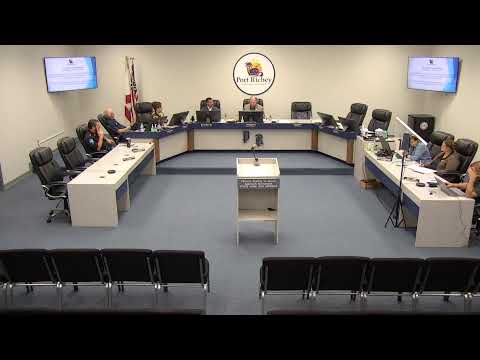
Mayor John Eric Hoover opened the quarterly town hall on June 2, 2026, and summarized recent state action sending a homestead-property tax amendment to the ballot that would, if approved by 60%, change how homestead exemptions are applied to local property-taxable values.
City Manager Don King presented the city's county-based modeling and said he applied 2026 appraisal data to the amendment's proposed exemption formulas. "I put 150 in here... at 150, 225 properties moved to pay zero taxes," King said, adding that Port Richey has 2,158 parcels, 659 of which are homesteaded. King said the modeled effect on total taxable value was about 10.4% under the initial $150,000 exemption.
The city manager explained the revenue implications in dollar terms: "The difference... is 49 million in taxable value. At our current millage rate we lose $38,635 at 150," King said, and noted revenue losses would grow substantially if the exemption rises to $250,000 or $500,000 in later phases. He also said the model treated already-exempt parcels (for example disabled-veteran exemptions) as zero-tax in the computation.
Council members asked King to share the underlying spreadsheet and formula for independent review; King agreed to circulate the county-level file and a Port Richey extract. King and the council emphasized timing constraints: even though the ballot outcome will not be known until November, the city must finalize a 2026'27 budget now.
Council discussion focused on options to address the projected shortfall. King and members discussed potential mitigations including pursuing state aid earmarked for disadvantaged cities, tightening assessment flags to verify homestead versus rental status, pursuing targeted annexation to add commercial tax base, applying for grants to offset capital needs, and considering fee adjustments for utilities where legally permissible. King warned that under the amendment some ad valorem revenues that were previously unrestricted could become restricted for essential services, which would limit local budgeting flexibility.
The council did not take any formal vote on policy changes during the town hall. King said staff would provide a more detailed analysis for the council's budget deliberations and promised to share the spreadsheet for council members to run their own scenarios.
The next procedural step is staff follow-up: circulate the model, prepare a deeper fiscal analysis for council review, and identify grant or state-aid options that might partially mitigate the impact.