Get Full Government Meeting Transcripts, Videos, & Alerts Forever!
Get email alerts on the Fire Ems Funding topic
No spam. Unsubscribe anytime.
Buckley leaders weigh hiring, reserve subsidy and service options after EMS fund projects negative
Summary
City staff told the Buckley City Council on Nov. 17 that the EMS fund is projecting a negative ending balance driven largely by rising fire department overtime and the transition to 24‑hour professional crews. Council discussed using reserve funds short term, hiring a budgeted fourth “rover” and longer‑term options including contracting with East Pierce or forming a fire authority.
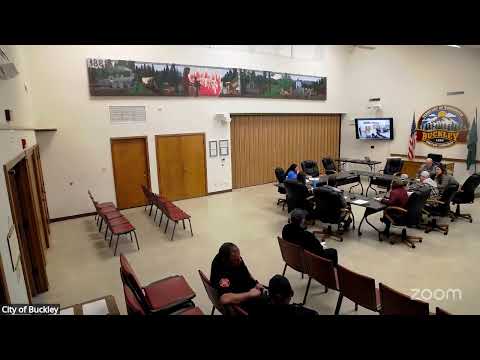
Buckley — City staff told the Buckley City Council at a Nov. 17 special study session that the EMS fund is projecting a negative ending fund balance and that the city must weigh short‑term subsidies, staffing changes and longer‑term service options.
"The EMS fund — the ending fund balance projected is in the negative," Director Hines told the council as she reviewed mid‑biennial adjustments. She said the shortfall is tied to increased overtime and costs after the department moved to 24‑hour professional crews earlier this year and incorporated bargaining terms that raised staffing coverage costs.
Why it matters: Council members were warned the shortfall is not sustainable without action. Staff recommended a short‑term subsidy from cumulative reserves while the city studies options to reduce overtime and stabilize service delivery.
What staff described: Chief Scogan and city staff outlined three contributing trends: hiring full‑time 24‑hour crews (changing shift patterns and coverage needs), union contract language that gives career firefighters first refusal on shifts, and heavier overtime use when shifts must be backfilled. Chief Scogan said the department relies heavily on volunteers and "we can't function without them" when discussing how volunteers and career staff currently share duties.
Council choices discussed: - Short term: Use one‑time reserve interest or cumulative reserves to subsidy the EMS fund and cover overtime until a longer plan is adopted. Director Hines noted there is interest earned on the reserve account that could be deployed as a one‑time fix. - Near term staffing: Hire the fourth budgeted rover position (a float/coverage role already in the 25/26 budget) to reduce the frequency of overtime backfills; several council members argued the rover could reduce burnout and cover recurring vacancies. - Labor negotiations: Staff will continue talks with East Pierce union representatives to explore options that lower overtime costs. - Long term: Consider service delivery changes such as contracting personnel with a neighboring agency, creating or joining a fire district/authority, or other regional arrangements. Staff presented a personnel‑only proposal from East Pierce that would deliver one engine 24/7 for roughly $3.4 million; adding a medic unit was presented as an additional ≈$1.9 million in personnel costs.
Council reaction: Several council members, while urging caution on long‑term service changes, expressed openness to hiring the fourth rover and to pursuing public education should a levy or levy lift be required in the future. Council Member Burbank said, "I just don't see how we can sustain even with a rover," reflecting concern about ongoing overtime exposure. Council Member Green emphasized preserving local control and the town's high level of service.
Next steps: Staff recommended, and council appeared to support in principle, a short‑term transfer from the cumulative reserve to subsidize the EMS fund while staff refines long‑term options and cost estimates. Director Hines said staff will update the mid‑biennial adjustments and bring an ordinance forward in December to record any reserve transfers.
Open questions and limits: Staff did not present a finalized multi‑year financial plan for the EMS fund at the session and did not take a formal vote. Several numbers discussed were preliminary and staff committed to returning with firmer cost projections, labor negotiation outcomes and a formal ordinance if the council directs reserve transfers.
Ending: Council and staff agreed on continuing union talks, preparing more detailed cost modeling for a rover plus contingency, and returning with ordinance language and budget amendments in December.