Get Full Government Meeting Transcripts, Videos, & Alerts Forever!
Get email alerts on the Building Energy Efficiency topic
No spam. Unsubscribe anytime.
Commission advances sustainable building incentive ordinance on first reading; staff asked for baseline data
Summary
City commissioners approved first reading of a new sustainable development section that uses a points checklist to reward energy‑saving and resilience measures with fee discounts and priority review; commissioners asked staff to return with data on recent permits to consider a possible mandatory baseline on second reading.
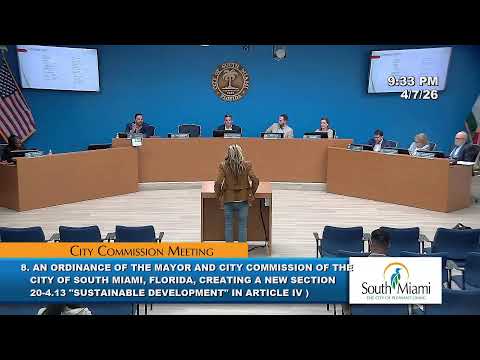
On first reading April 7, the South Miami City Commission approved a proposed land‑development code section that establishes a tiered checklist of sustainable design measures for new single‑family and small multi‑family projects. The ordinance would let applicants accrue points for measures such as cool/reflective roofs, preserved tree canopy, permeable paving, operable windows and other low‑impact site features; reaching specified point thresholds would unlock incentives including permit‑fee discounts and prioritized review.
Staff described a simple staff‑verified checklist form the applicant would submit during zoning review. Planning & Zoning asked for implementation simplicity; staff said the checklist will be validated against submittals during the routine zoning/plan review process. The city attorney and staff noted national certifications such as LEED are complex and costly for single‑family projects, so the locally tailored, points‑based approach aims to be easier to implement and more directly tied to local climate and canopy goals.
Commissioners debated whether at least one tier or a minimum standard should be mandatory rather than purely voluntary. Mayor Fernandez and other commissioners asked staff to return before second reading with an analysis of recently permitted local homes (to show how many already meet particular point thresholds) and cost‑impact data so the commission can consider whether to require a minimum baseline on the second reading.
The ordinance passed first reading by voice roll; commissioners asked staff to provide a project‑level inventory and recommendations for a potential minimum requirement at second reading.