Get Full Government Meeting Transcripts, Videos, & Alerts Forever!
Get email alerts on the Parks Recreation topic
No spam. Unsubscribe anytime.
South Miami adopts 10‑year Parks Master Plan; landscape plan accepted for implementation
Summary
The commission adopted a 10‑year Parks & Recreation Master Plan and accepted a companion Landscape Master Plan that lays out phased capital improvements, maintenance planning and design standards. The plans prioritize repairing existing assets, expanding canopy, and targeted intersection streetscape upgrades with estimated focus‑intersection costs ranging $81K–$354K.
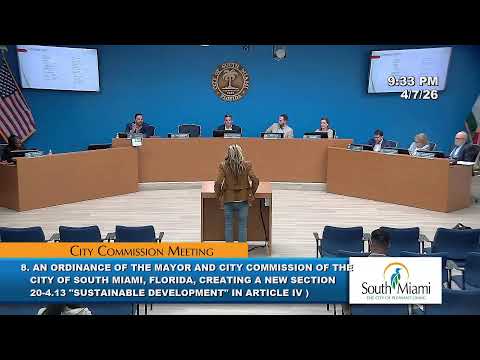
The South Miami City Commission on April 7 adopted a 10‑year Parks & Recreation Master Plan and accepted a Landscape Master Plan laying out prioritized capital projects, maintenance strategies and policy changes for streets and public spaces.
Hadley Peterson of Kimley Horn presented the parks plan as a roadmap that grew from a statistically valid community survey and engagement that reached more than 5,000 residents and stakeholders. The plan recommends five vision principles—bold public spaces, connected parks, inclusive programs, active recreation and resilient natural areas—and a three‑phase implementation schedule spanning immediate stabilization work, medium‑term growth and long‑term transformational projects.
"Everything from social media to attending events like Fourth of July and the Safe Streets Halloween event contributed to the plan," Hadley Peterson said in her presentation, noting the survey had a margin of error under 5 percent.
Key, conceptual project sites identified in the plan include expanded facilities at South Miami Park, a kayak launch at Welsh Junior Park, and a redesigned Palmer Park with additional indoor and outdoor active recreation. The plan recommends retaining a level‑of‑service standard of four acres of parkland per 1,000 residents while targeting roughly 65–75 percent of park acreage toward active recreation and the remainder to passive natural areas.
The Landscape Master Plan, developed by consultants from Miller Leg and reviewed by staff, is framed as a policy and design guide (not street‑by‑street construction plans). It categorizes corridors by function, proposes three planting themes (Florida/native, tropical and pollinator for overhead‑utility constrained areas) and recommends a standard hardscape palette centered on gray concrete with a blue glass aggregate and optional green accent bands.
Consultants showed conceptual intersection typologies (Type A residential, Type B commercial) and a leaf‑motif hardscape treatment adaptable to different sidewalk widths. They presented seven focus intersections for near‑term work and a per‑intersection conceptual cost range of about $81,400 to $354,000. City staff said adding design fees and contingencies brings the typical fully loaded cost nearer to the $200K–$250K range per intersection in many cases.
Commissioners and the city manager discussed procurement options (piggybacking on county contracts where possible, obtaining quotes) and funding sources including the city’s tree trust and available capital dollars. The city manager said an initial canopy allocation of $85,000 is available and that staff will pursue design and construction packages, partnerships, and a follow‑up commission item to authorize tree‑planting expenditures.
Public commenters urged the city to preserve and replace the South Dog Park amid ongoing negotiations over Elks Lodge property and recommended careful plant species selection. Consultant Peterson said the parks plan includes a provision to match the existing dog‑park square footage if needed and provides site‑selection standards for new dog‑park locations.
The commission approved the parks master plan by a recorded 4–0 vote and indicated the landscape plan would be taken as accepted for implementation and used to guide design, procurement and future funding requests. Staff will return with more specific implementation steps, cost estimates for identified focus intersections, and follow‑up on dog‑park siting and tree‑planting action items.
The commission’s adoption will let staff begin site‑specific design, apply for grants and integrate plan recommendations into upcoming capital budgets.