Get Full Government Meeting Transcripts, Videos, & Alerts Forever!
Get email alerts on the Plan To Play Overview topic
No spam. Unsubscribe anytime.
Presenter outlines Plan to Play 2026 update, prioritizes $127 million deferred maintenance and $188.8 million five-year capital plan
Summary
At a Board of Parks and Recreation meeting, a presenter summarized Plan to Play 2026, the update to the 2017 countywide parks and greenways master plan, and outlined a tiered five-year action plan that prioritizes roughly $127 million in deferred maintenance and a Tier‑1 capital package of about $188.8 million.
At a Board of Parks and Recreation meeting, a presenter outlined Plan to Play 2026, an update to the countywide parks and greenways master plan first completed in 2017. The presenter said the update concludes with an action plan and five‑year work plan through 2031 and recommended prioritizing a $127 million deferred maintenance backlog while phasing new projects through a three‑tier funding approach.
"Plan to Play is the countywide parks and greenways master plan," the presenter said, describing the update as a continuation of the 2017 plan rather than a restart. The briefing credited nearly 600 acres added to the system since 2017 but warned that population growth has reduced acres per capita, lowering the system’s level of service for land and some facility types.
Why it matters: the presenter said condition assessments identify more than $127 million in deferred maintenance needs — paving, roofs, bridges and HVAC systems — that staff recommend addressing aggressively alongside establishing steady life‑cycle funding so routine maintenance prevents additional backlog.
The update groups recommendations by land/open space, facilities, greenways, programs, operations and funding. It emphasizes collaboration between public agencies, nonprofit partners and private developers to diversify funding and expand capacity. The presenter noted philanthropic partners have contributed more than $28 million since 2021, which helps supplement Metro resources.
Land and greenways: the plan proposes specific criteria for prioritizing land acquisition — equity and access (targeting underserved, higher‑density areas), conservation value (riparian corridors, scenic or ecological function) and partnership/funding opportunity. The presenter said greenway development is especially reliant on partnerships and that updating the countywide parks and greenways map is critical because those corridors affect regulatory approaches to development.
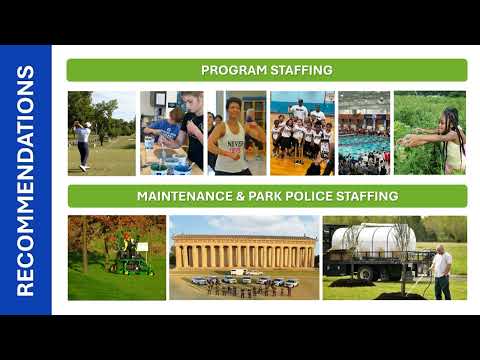
Funding tiers and the Tier‑1 package: the action plan is organized around three funding tiers to match different fiscal scenarios. Tier 1 assumes flat funding and is the baseline priority. The presenter said Tier 1’s five‑year capital estimate is about $188.8 million, broken down roughly as $40 million to tackle backlog capacity aligned with staff capacity, $89 million for life‑cycle and routine maintenance funding, $8 million projected for land acquisition and about $51 million for new projects; the Tier‑1 operating ask of about $11 million would add maintenance, park police and program staff to support the work.
Projects and capacity: the presenter listed ongoing commitments that Tier 1 preserves and completes (for example, West Park Community Center, Cedar Hill Miracle League and Whites Creek Greenway) and noted greenway miles on the presented map total roughly 17 miles of projects coming online without new funding. In Tier 1 the team estimates adding about 390 acres; Tier 2 would aim to match system growth to population increases and projects about 500 new acres and a larger five‑year capital and operating package.
Program staffing and demand: the presenter urged full staffing at nature centers and revenue‑producing facilities and expanding wait‑listed programs such as afterschool and summer enrichment, saying staff currently must turn away hundreds of families for summer programs.
Next steps: staff will bring a proposed DNA (designated natural areas) policy and a first cohort of candidate DNA sites for Board review and may explore a DNA ordinance at the Metro Council level. The presenter said the action plan is designed to feed into the mayor’s office and Metro Council budget processes and that the five‑year work plan will be refined each budget cycle. "I am happy to answer any questions," the presenter concluded.
The meeting did not record a formal vote or motion on Plan to Play 2026; the presentation will inform upcoming mayoral and Metro Council budget discussions.