Get Full Government Meeting Transcripts, Videos, & Alerts Forever!
Get email alerts on the Behavioral Health Workforce topic
No spam. Unsubscribe anytime.
State agency unveils draft BHSA 2026–2030 workforce plan, seeks public comment
Summary
The Department of Health Care Access and Information presented a five‑year Workforce Education and Training (WET) plan under the Behavioral Health Services Act that targets workforce supply, skills and diversity across five objectives; public comment on the draft closes May 29, 2026.
The Department of Health Care Access and Information (referred to in the webinar as HAI) on Friday presented a draft five‑year Workforce Education and Training (WET) plan under the Behavioral Health Services Act (BHSA) that aims to expand and better align California’s county behavioral health workforce.
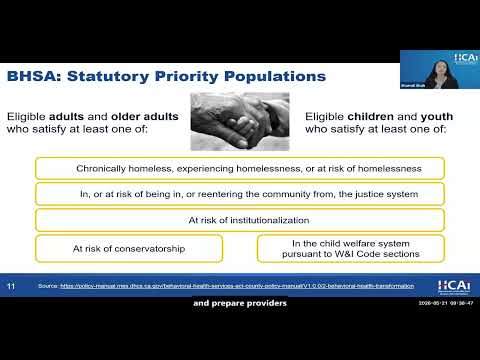
Libby Abbott, the department’s deputy director for health workforce development, said the plan was built from months of community engagement and is designed to serve people “with significant behavioral health conditions,” prioritizing statute‑defined populations and investments in training, supervision and job pathways. “This plan is the product of many months of community and partner engagement and your voice continues to be essential as we move towards finalization,” Abbott said.
Why it matters: HAI framed the WET plan as an effort to close gaps left by recent one‑time investments—such as the children and youth behavioral health initiative and BH Connect—that expanded services but, the agency said, did not sufficiently grow the county behavioral health workforce. The plan focuses on three outcomes—supply, skills and diversity—intended to improve access and culturally responsive care in county‑operated and county‑contracted settings.
What the draft proposes: HAI described five objectives that will guide investments and programs: - Objective 1: Expand skills of the existing workforce through competency definitions, curriculum gap analyses, and immediate funding for prioritized trainings (examples cited included the SMI Advisor and mental health first aid). - Objective 2: Expand licensed workforce education by funding curriculum development, scholarships, and pilot programs to increase training slots and clinical placements for disciplines such as social work, marriage and family therapy, and clinical counseling. - Objective 3: Scale non‑licensed workforce training (peer support specialists, SUD counselors, mental health rehabilitation specialists) and fund transition‑to‑practice supports and technical assistance so trained workers move into jobs. - Objective 4: Develop clearer career pathways, stackable credentials and bridging programs to help early‑career and non‑licensed staff advance into higher‑level roles. - Objective 5: Support recruitment and retention, coordinated with BH Connect; HAI said it will evaluate the first BH Connect recruitment cycle (launching in the coming weeks) to identify gaps before committing BHSA funds for this objective.
Budget and timing: The WET plan is a five‑year program; HAI provided draft budget allocations for the first three years and said it will conduct a midline assessment in year three to adjust years four and five. Officials emphasized leveraging other funds—particularly BH Connect (an approximately $1.9 billion, five‑year initiative that includes a recruitment and retention program with up to $821 million allocated)—before committing BHSA state funds. HAI said the WET plan’s 3% workforce allocation is drawn from the state’s share of BHSA dollars, not from county shares.
Panelists described four budget principles: maximize leverage of other funds, balance licensed and non‑licensed investments, invest upfront for systems change (for example, curriculum gap analyses), and prioritize sustainability. HAI plans ongoing program monitoring and baseline/midline/endline evaluations and will convene a BHSA workforce panel to review progress.
Stakeholder questions: During a Q&A, attendees raised several operational questions: whether school‑based preparation programs would be included (HAI said schools are not the primary emphasis but will be considered), whether counseling and other clinical disciplines would be eligible for graduate education expansion (HAI said yes), how residency and dual‑training programs (for example combined primary care and psychiatry) might be supported, and how to avoid oversupplying peer support specialists where counties do not yet have hiring or billing capacity. HAI said it will co‑design technical assistance with counties and county‑contracted providers to address uptake and billing barriers.
Public comment and next steps: HAI opened a public comment period on May 12; comments close at noon on May 29, 2026. The agency plans to present a final proposed WET plan to the California Behavioral Health Planning Council on June 19, 2026. HAI asked stakeholders to submit comments via the resources tab on the WET plan web page or by email to bhsaworkforce@hai.ca.gov.
What the plan does not yet commit: HAI emphasized it has not finalized allocations for recruitment and retention under Objective 5 pending an assessment of BH Connect reach and gaps; officials said the assessment of who receives BH Connect funds will be available within weeks after the first cycle and will inform BHSA decisions.
The webinar recording and related resources were provided on HAI’s website; the department encouraged stakeholders to join its mailing list for updates.