Get Full Government Meeting Transcripts, Videos, & Alerts Forever!
Get email alerts on the Land Use Development topic
No spam. Unsubscribe anytime.
Kuna Council denies Seasons Creek development‑agreement modification amid traffic, school safety and process concerns
Summary
After a public hearing that drew neighborhood opposition and school‑district input, the Kuna City Council voted to deny a proposed modification to the long‑running Seasons Creek development agreement (Case 26‑01‑DA). Residents raised concerns about railroad crossing traffic, notice and whether the DA had effectively lapsed.
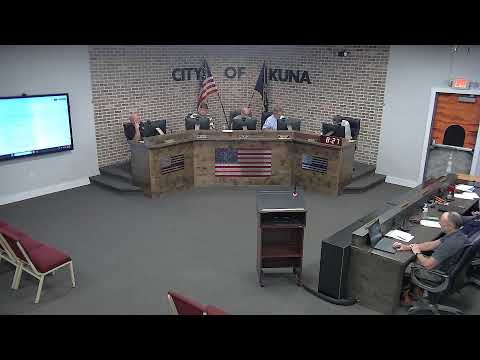
Kuna City Council on Monday denied a requested modification to the Seasons Creek development agreement (Case 26‑01‑DA) after public testimony raised concerns about traffic at nearby rail crossings, school‑site safety and neighborhood notice.
Senior planner Troy Behunan presented the project history and staff analysis, noting the property was annexed in 2006 and the recorded development agreement dates to 2008. The applicant proposes to preserve the originally approved total of 637 residential lots while updating the plan to current city standards, relocate a commercial node to Black Cat Road and reserve a 10‑plus‑acre school site for the Kuna School District.
Developer counsel Elizabeth Kekeritz framed the request as a “modernization of an already approved project, not a new entitlement request,” and said the project could not proceed earlier because sewer service and a railroad sewer crossing were not available until recent years. She described updated connectivity, open space and a phased approach via three preliminary plats.
But neighbors and other speakers urged the council to reject or require more public review. Diana Sanders, a nearby resident, told councilors, “When you do a development agreement and you don't comply with the 365 days, it kind of voids that development agreement out,” and asked that the city re‑engage the neighborhood. Several property owners said they had not seen the current plan before the meeting and voiced concerns about access, adjacent commercial zoning, and the proximity of a school site to railroad tracks.
Tim Jensen of the Kuna School District expressed support for the school‑site location and said safety measures such as perimeter fencing would be a priority. Project consultants and the developer said the plan includes more than 26 acres of usable open space, nearly 104 acres of R‑6 residential acreage, about 6 acres of commercial zoning and 98 larger lots of roughly 11,000 square feet; they also said the project would pay more than $6.6 million in impact fees across agencies.
Council discussion focused on tradeoffs: the project’s public benefits (school site, parks and sidewalks, and infrastructure commitments) versus lingering community concerns about traffic at Black Cat and Greenhurst, the degree of neighborhood outreach, and the unresolved question of whether the DA had been effectively defaulted in prior years. Council member McFersonson recused himself before the vote because of prior involvement with the project.
A motion to deny the modification application was made, seconded and carried. The city attorney and staff clarified that formally terminating or defaulting the development agreement is a separate legal process that would require its own public hearing; council discussion indicated staff should evaluate next steps. The denial preserves the status quo: the recorded development agreement remains on the record until and unless the council initiates a separate termination procedure or the applicant files a different application.
What happens next: the applicant may return with a different proposal, the city could elect to initiate a termination/default process (which would require additional public hearings), or the parties could pursue negotiated amendments. Any future steps that would change zoning or add preliminary plats would go through required planning‑and‑zoning and council public hearings.