Get Full Government Meeting Transcripts, Videos, & Alerts Forever!
Get email alerts on the Cooling Corridors Grant topic
No spam. Unsubscribe anytime.
Massachusetts opens third Cooling Corridors round, pilots MassEnviroScreen to target ‘burdened areas’
Summary
The Executive Office of Energy and Environmental Affairs opened a third round of Cooling Corridors tree-planting grants with a $75,000 maximum award, a 10% match and a mandatory two-year watering requirement; the program will pilot the MassEnviroScreen tool to identify 'burdened areas' for scoring.
The Executive Office of Energy and Environmental Affairs on the third round of its Cooling Corridors tree-planting grant program, offering a maximum request of $75,000 per project and requiring a 10% match and two full years of post-planting watering.
"This program primarily funds tree planting projects throughout the Commonwealth," said Hilary Dimino, Tree Planting Program Manager in the Division of Conservation Services, who led the information session. Dimino said the award must be spent across fiscal years 2027 and 2028 and that the program is reimbursement-based, so applicants must be prepared to incur costs up front.
The round will be processed through EEA's consolidated Eco One Stop portal. Dimino said the request for responses (RFR) will be released Jan. 20 and applications must be submitted through the grant portal by March 20; awards are expected in June with contracting targeted for July 1, 2026. Projects funded under the grant are expected to run from July 1, 2026, through June 30, 2028.
Applications must include a project narrative, a budget split across fiscal years 2027–2028, a planting plan and a tree-watering plan that documents how trees will be watered for two consecutive years. Dimino emphasized that watering must be regular (a minimum of 20 gallons per week per tree during the growing season was specified in the session) and that proof-of-payment documentation will be required for reimbursements. She also said that costs incurred before a formal award are not eligible.
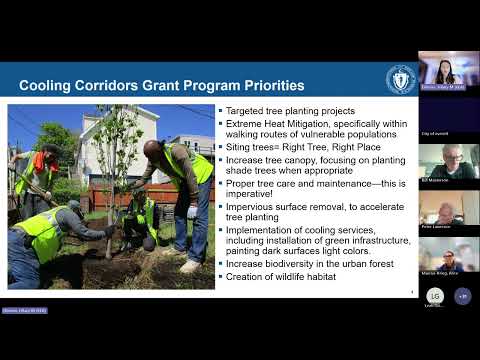
Eligible applicants include municipalities, nonprofit organizations, tribal governments, public and private schools, and public boards and commissions. Projects that remove impervious surfaces to create planting space, add green infrastructure, or plant along walking routes to schools, senior centers and transit stops will be prioritized. Dimino said the program favors planting larger shade trees where appropriate and seeks to increase urban-forest biodiversity.
The program includes species and site restrictions tied to pest management and local quarantines: "We will not want to see any ash trees planted," Dimino said, and she advised against planting beech where Beech Leaf Disease is present; additional restrictions apply in Worcester’s Asian longhorn beetle restrictive zone.
EEA is piloting a new screening tool, MassEnviroScreen, developed by the Office of Environmental Justice and Equity to identify census block groups that experience overlapping pollution, climate and social vulnerabilities. "MassEnviroScreen is a new statewide environmental justice screening tool that has been developed by the Office of Environmental Justice and Equity within EEA," said Syena Mashmis Army, an environmental justice liaison, during a walkthrough of the tool.
Kara Rensten, MVP program director, said the tool is intended to replace prior references to "EJ populations" in the grant application and to help align resources with communities facing the highest cumulative burdens. Rensten described the pilot as an opportunity for applicant feedback before broader use: "This is a new tool that's being designed to identify areas experiencing overlapping environmental, climate and social vulnerabilities."
MassEnviroScreen combines 30 indicators in five component categories — environmental exposure, environmental effects, climate risk, sensitive populations and socioeconomic factors — to create a cumulative burden score for each census block group. A block group is designated a "burdened area" for the grant if it has a MassEnviroScreen score at or above the 75th percentile statewide or a median household income of 65% or less of the statewide median; applicants may also use elevated indicator-level values to make the case for funding in areas that do not meet the overall burden threshold.
Scoring in the RFR awards up to 10 scaled points for projects located within burdened areas and up to five points for projects that demonstrate elevated indicator-level needs; 50 points are allocated to project benefits such as location, watering plans and biodiversity outcomes. Dimino encouraged applicants to reference indicator-level data in MassEnviroScreen to strengthen applications.
Dimino said eligible project costs include tree purchases, watering labor and equipment, impervious-surface removal and soil remediation, and implementation of cooling services (for example, lighter surface coatings or porous pavement) in tandem with plantings. She noted the program requires either a Massachusetts-certified or ISA-certified arborist to be present to manage planting days and offered DCR urban-forestry fact sheets and contact support through the Cooling Corridors website.
During the question-and-answer portion, Dimino confirmed projects proposed outside designated burdened areas may still be considered for funding if they demonstrate elevated indicators; those submissions can receive partial scoring under the burdened-area criterion. She also said routine maintenance and public-education projects (such as a citizen-pruner program) are eligible but that the grant does not fund sidewalk reconstruction where sidewalks are being repaired because of tree damage — it will only fund removal of impervious surface to create tree pits.
EEA provided an OEJE contact email for MassEnviroScreen feedback (ej.inquiries@mass.gov). Dimino said the recording and slides from the information session will be posted on the Cooling Corridors webpage and encouraged prospective applicants to attend Eco One Stop webinars and the portal how-to sessions ahead of the March 20 deadline.