Get Full Government Meeting Transcripts, Videos, & Alerts Forever!
Get email alerts on the Capital Investment topic
No spam. Unsubscribe anytime.
Arlington outlines $286 million, 10-year parks capital plan; boat house, Gateway Park and restroom upgrades highlighted
Summary
Arlington Parks staff presented a proposed $286 million, 10-year Capital Improvement Plan emphasizing maintenance, field replacements, trails and several major projects including the Arlington boathouse; staff said the manager-proposed plan fits county debt guidelines and includes federal earmarks and developer contributions.
Eric Beach, park development division chief for Arlington’s Department of Parks and Recreation, presented the department’s proposed 10-year Capital Improvement Plan (CIP) and asked commission members to review projects that would feed into the county’s budget and upcoming public referendum process.
“I’m Eric Beach. I’m the park development division chief for the Department of Parks and Recreation,” Beach said as he opened the presentation, explaining the CIP covers 10 years of planned investments and that projects in the first two years would be the items subject to voter consideration in the fall.
Beach described the CIP as a cross-government plan that bundles many county needs — parks, transportation, public safety and technology — while sticking to a local fiscal rule of keeping debt-service below roughly 10% of annual budget capacity. He said the manager-proposed plan fits those financial parameters.
Beach walked commissioners through the department’s asset-management process: a condition-assessment score (0–100) derived from on-site inspections, combined with an annually updated equity factor that weighs neighborhood demographic and socioeconomic indicators. The combined score determines priorities across the system’s roughly 147 parks and thousands of park assets.
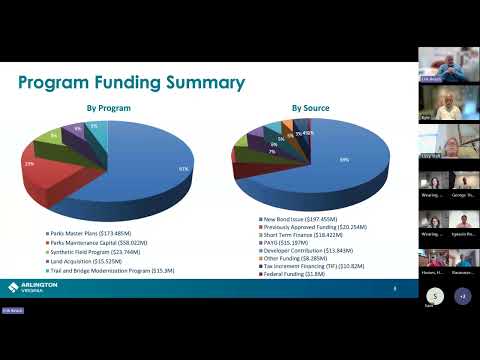
The presentation listed short-term park investments and several multi-year projects. Beach said the county is proposing about $286 million in park-related investments over 10 years and roughly $40 million in FY27. He identified several projects called out in the proposal:
- Douglas Park phase two: a $2.4 million renovation for playground and community gathering areas, of which $1.85 million is funded by a federal earmark; - Gateway Park: major design and construction tied to nearly $18 million in outside developer contributions; - Crystal City Metro Market Square and Penrose Square: developer-provided parcels and partner-funded public spaces; - Arlington boathouse: ongoing master planning and a programmatic agreement with the National Park Service, plus an agreement with the Arlington Boathouse Foundation for fundraising; Beach said roughly $15 million is proposed for the lower-site work in the later years of the CIP and additional upper-site work is planned in a subsequent cycle.
Beach also reviewed programmatic funding categories: park maintenance capital, park master plans, synthetic turf replacements, land acquisition, and a trails and bridge program. He said the department has secured outside funding — including developer contributions and some federal funds — which reduce the county’s share of total costs.
On facility costs, Beach explained that prefabricated restroom replacements are often less expensive than ground-up construction but can still approach roughly $1 million after purchase, installation, utilities and contingencies are included. He summarized the 10-year field-replacement schedule and said synthetic turf fields generally have an 8–10 year replacement cycle depending on use.
Commissioners asked a series of clarification questions. When asked why Gateway Park appeared costlier than Quincy Park, Beach said differences in hardscape and site constraints (including bridge-related costs) can raise per-square-foot construction costs. On equity scoring, he said the county uses a community vulnerability index that incorporates demographic and economic indicators to identify historically underinvested areas and that the choice of metrics is a staff and policy-level discussion.
Beach closed by confirming staff would distribute presentation materials and follow up on detailed questions.
What’s next: Beach said department staff will present the CIP to the county board in a scheduled work session and the board will hold public-comment opportunities before finalizing what goes into the referendum for resident voting.