Get Full Government Meeting Transcripts, Videos, & Alerts Forever!
Get email alerts on the Gaming Regulation topic
No spam. Unsubscribe anytime.
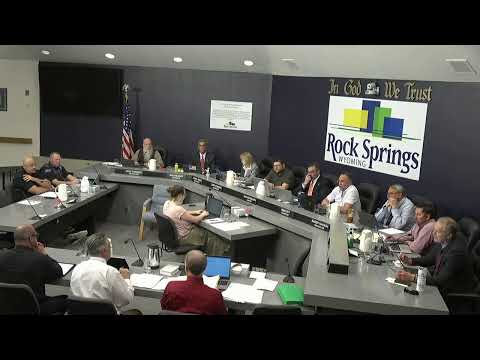
Rock Springs council moves to amend local-approval ordinance for off-track betting terminals, sends revised ordinance back for final vote
Summary
The council heard operator and resident testimony about off-track betting (OTB) and historic-horse-racing terminals, accepted legal edits and extended administrative review timelines to give staff more time; the amended ordinance will return for a final vote at the next meeting.
Brent Rhodess urged the Rock Springs City Council to adopt a local-control ordinance for off-track betting (OTB), saying the city could set a model for other Wyoming municipalities and that residents had lacked a formal way to weigh in on OTB locations and operations.
A representative for Wyoming Downs and other operator interests described how the permitting process has historically been led by county referendums and the state gaming commission; under the recent local-control legislation, municipalities will gain a separate layer of local approval to address location, operating restrictions and community concerns, the representative said.
Council discussion focused on how a municipal ordinance would interact with county and state approvals. Several councilors asked whether a uniform statewide form ordinance would be preferable; speakers said uniform templates are useful but that local conditions — for example, an OTB inside a bar or shopping center — make locally tailored rules necessary.
On the ordinance before the council (Title 11, new Chapter 119), Councelor Hickerson moved to accept a set of legal edits provided by the city attorney with specific changes to administrative timelines. The council voted unanimously to amend the draft: staff review windows were extended (from five business days to 10 in one provision and from two to five business days for written deficiency notices), and related calendar calculations were adjusted to preserve overall applicant timelines. The amended ordinance will be presented in final form at the next council meeting.
The meeting record shows councilors and supporters framing the change as restoring municipal input rather than supplanting state authority. No final permit was granted at the meeting; the vote approved specific textual amendments to the ordinance, not the issuing of any operating licenses.
The ordinance draft and the council’s adopted amendments will be published with the clerk’s packet ahead of the next meeting, when councilors will consider final adoption.