Get Full Government Meeting Transcripts, Videos, & Alerts Forever!
Get email alerts on the Mass Enviro Screen topic
No spam. Unsubscribe anytime.
State to pilot Mass EnviroScreen for FY27 MVP Action Grant applications
Summary
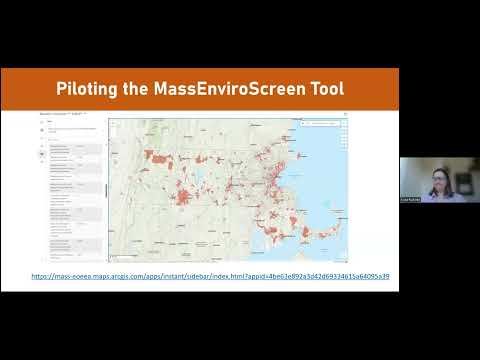
The MVP program will pilot the Mass EnviroScreen mapping tool in the FY27 Action Grant round through the ECO One Stop application to identify 'burdened areas' and provide indicator-level data applicants can cite; presenters said the tool will be a screening input, not the sole funding determinant.
Kara Runston, director of the Municipal Vulnerability Preparedness (MVP) program, announced that the upcoming FY27 Action Grant round will pilot the Mass EnviroScreen mapping tool through the new Environment & Climate (ECO) One Stop application process.
Runston said the tool, developed by the Office of Environmental Justice and Equity within the state Executive Office of Energy and Environmental Affairs (EEA), is being introduced to help identify communities with overlapping environmental, climate and social vulnerabilities and to align grant decision-making with the state's environmental-justice commitments. "We are thrilled to have Syena from the Office of Environmental Justice and Equity here to talk more about the tool and start to socialize it with you all," Runston said during the webinar.
Syena Mashmis Army, an environmental justice liaison with the Office of Environmental Justice and Equity, explained how the tool works. Mass EnviroScreen combines 30 indicators grouped into five components—environmental exposure, environmental effects, climate risk, sensitive populations and socioeconomic factors—into a cumulative burden score for each census block group. Indicators are percentile-ranked across the state, averaged into component scores, and then combined so the final score reflects both pollution/climate burden and population characteristics.
Syena said the tool displays indicator-level values and percentiles so users can see localized conditions. Under the pilot, a census block group will be considered a "burdened area" if it meets one or both of these criteria: a Mass EnviroScreen score at or above the 75th percentile statewide, or an annual median household income that is 65% or less of the statewide median. Syena noted that "higher scores will indicate a greater combined environmental and social vulnerability for that community." She encouraged applicants to review indicator-level results even when a block group is not formally designated a burdened area.
During the Q&A, attendees raised concerns that a statewide screening tool could disadvantage less-populated or rural communities. Presenters emphasized the tool is intended as a screening input—not the sole determinant of funding—and that it will be used alongside other application criteria that account for local context, project benefits and program goals. Presenters also said indicator-level data can be used to demonstrate local vulnerabilities that do not produce a burden-area designation.
Presenters acknowledged limitations and open questions: the current tool does not include infrastructure age as an indicator, and staff said they would follow up about how the tool handles incarcerated populations and census blocks that contain correctional facilities. They also said export/data-report functionality for indicator tables is planned in the near future to improve transparency and usability.
The pilot will be demonstrated again during the ECO One Stop webinars that follow the application release; the MVP team asked applicants to share feedback on how the tool performs in the grants context.