Get Full Government Meeting Transcripts, Videos, & Alerts Forever!
Get email alerts on the Voting Systems topic
No spam. Unsubscribe anytime.
Georgia State Election Board hears hours of testimony on QR‑code ban and voting security; issues reprimands and urges county planning
Summary
Board meeting centered on SB 189 (phase‑out of QR‑code ballot marking) and voting‑system security. Experts warned that OCR/image tabulation raises attack surface; counties and public urged the board to issue contingency guidance. The board continued many investigative cases and issued a letter of reprimand in one poll‑worker interference matter.
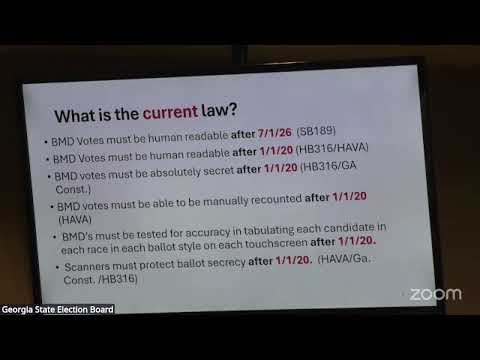
The Georgia State Election Board spent the April 15 meeting focused largely on SB 189 — the law phasing out QR‑code‑based ballot marking devices — and on proposals to use optical‑character‑recognition (OCR) of ballot images as an alternative. After hours of public comment, technical testimony and contested enforcement hearings, the board voted to continue the bulk of pending investigatory cases for additional documentation and issued a formal letter of reprimand in one poll‑worker interference matter.
Board members opened the meeting by adjusting the agenda to permit several late‑added speakers and then moved into a multi‑hour public comment period in which election directors and residents described operational, legal and technical challenges tied to the July 1 deadline in SB 189. Tom Ruts, an elections official in Hall County, presented a cost and throughput comparison, saying BMD‑printed ballots can be cheaper per page but that the overall staffing, logistics and ballot‑style complexity make a wholesale, same‑year transition to hand‑marked ballots difficult for larger counties.
A remote presentation by Princeton computer scientist Andrew Appel warned against adopting an OCR‑based tabulation pipeline as the official count. Appel summarized the workflow used in a 2024 OCR audit — digital images scanned by county tabulators, then uploaded to a cloud server operated by a third‑party vendor for OCR — and argued the multistep transfers create opportunities for substitution of image files, make the pipeline functionally uncertified, and remove the ‘‘software‑independence’’ advantage of hand‑marked paper ballots. He recommended counties plan now for paper ballots and for risk‑limiting audits tied to physical ballots, rather than relying on uncertified OCR systems.
Several cybersecurity experts who testified or submitted reports echoed that view, arguing the entire integrated system — not only QR codes on BMD‑printed paper — presents vulnerabilities if software, image files or election management databases are not tightly controlled, patched and logged. One forensic examiner who has reviewed county images said systems inspected in prior elections retained insufficient logs and had not applied recommended security updates.
The board also moved through its enforcement docket. With investigators’ written packets missing the investigators’ explicit ‘‘potential violation’’ paragraphs and some evidence, the chair called for a continuance of a long list of cases; the board voted to continue the named items en masse. In Fulton County’s double‑voter allegation docket, county staff explained that duplicate registrations and legacy database migration artifacts can create misleading ‘‘voter credit’’ traces; the board reviewed the evidence and, on separate contested allegations elsewhere, dismissed at least one complaint for lack of corroborating documents.
A contested complaint from Cherokee County alleging poll‑worker interference by a precinct chair prompted extensive testimony. Cherokee witnesses described a moment when a voter, Richard Jordan, held his printed ballot in front of a young poll worker and loudly asked whether the QR code reflected his candidate choice, which they said left the clerk ‘‘flustered’’ and unable to perform duties. Jordan said he only asked a procedural question and immediately deposited his ballot. After deliberation the board voted to issue a letter of reprimand (the board declined to issue a cease‑and‑desist) and to send the letter into the record; members framed the choice as balancing a voter’s right to ask procedural questions with the need to protect poll workers from conduct that impedes their duties.
Throughout the afternoon board members pressed the secretary of state’s office and county election directors for near‑term contingency planning. Multiple board members and commenters urged a work session within days to gather election administrators, cybersecurity experts, county directors and legal counsel so counties can evaluate procurement, training, ballot‑on‑demand options and daily chain‑of‑custody procedures if SB 189 takes effect without additional legislative action.
Board chair and members said they would not delay advising counties to prepare for the ‘‘worst‑case’’ scenario — a July 1 change in law without new statewide funding or procurement — and several board members asked staff to set an expedited work session to identify practical, implementable steps counties can start this week. The board also received a formal petition to adopt a rule requiring a handwritten, numbered paper check‑in list for early voting and election day (a paper ‘‘numbered list of voters’’) to create an auditable daily reconciliation; members asked for follow‑up on implementation logistics, protected‑records handling and how the paper list would be reconciled with electronic poll books.
What happens next: the board continued dozens of investigatory files for supplemental reporting and agreed to pursue internal and public work sessions to develop guidance for counties. The board did not adopt new statewide mandates during the meeting; it did vote to issue the reprimand described above and to press the secretary of state’s office for fuller investigative packets when cases are submitted for adjudication.
The meeting demonstrated clear divisions: some board members and public speakers urged immediate statewide direction and action consistent with SB 189 and state law; others stressed that rushed, statewide mandates absent funding, procurement lead time and tested procedures risk confusing voters and poll workers. The board said it will convene additional meetings and work sessions to narrow those issues and provide practical guidance to counties before summer deadlines.