Get Full Government Meeting Transcripts, Videos, & Alerts Forever!
Get email alerts on the School Security topic
No spam. Unsubscribe anytime.
District security chief outlines new site emergency plans, weapons screens and an emergency app
Summary
Auggie Ballesteros told the Douglas Unified School District board the district has overhauled its Emergency Operations Plan into site-specific EOPs, is operating weapons-detection stations at high school choke points, and is deploying an emergency-management app and threat-monitoring tools to improve response and auditing.
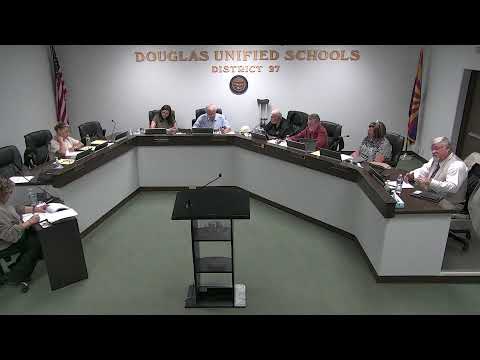
Auggie Ballesteros, the district's security lead, told the Douglas Unified School District governing board that the district has rewritten its Emergency Operations Plan and is requiring every school to adopt a site-based EOP before the next school year.
Ballesteros said the district "have a new EOP now" and that principals must assemble command staff, ensure staff are trained, and get Miss Samaniego's sign-off; the completed site plans will also be routed to police and the fire chief for review. He described the EOP as an "extensive" four-part document that includes a standard response protocol to guide holds, secures and lockdowns.
Why it matters: the changes respond to auditor expectations and to operational complexity at larger campuses. Ballesteros emphasized documentation for audits, saying security teams perform three mandatory checks daily (morning, after lunch and end-of-day) and record time-stamped entries so auditors can verify compliance.
On weapons-detection, Ballesteros said the high school runs multiple screening stations in the morning and then "collapse[s]" to one secured entrance after students are in class to control access. "We have to man those to make sure that no one's bringing in anything that they're not supposed to be bringing in," he said. He acknowledged that staff must be disciplined—teachers are currently required to keep classroom doors locked when instructing—because some physical measures (for example, door sleeves) were removed at the direction of the fire marshal.
The superintendent and Ballesteros discussed technology the district is using to detect threats and speed response. The district has a one-touch emergency-management app that can send medical, fire or intruder alerts to dispatch; Ballesteros recounted a medical incident in which a teacher used the app and the police and fire department arrived quickly. The board heard that the district also monitors student internet searches with a tool called Bark to flag potentially concerning searches and route notifications to counselors or principals.
Board members asked about site-specific threat assessments and continuity planning. Ballesteros said those assessments require certified evaluators from ACTIC and that scheduling certified assessors has been difficult; he also said the district's continuity-of-operations plan dovetails with the EOP and designates second- and third-level backups to initiate emergency response if primary leaders are unavailable.
Other operational items discussed included: daily briefings for substitute teachers (to offset high substitute turnover), increased camera coverage (24/7 recording with priority on blind spots), formation of a safety committee that includes principals, and phased consideration of a key-card access system for campus choke points pending cost estimates.
Board members pressed on gaps and next steps: camera coverage of off-site athletic fields remains a future budget decision, and the district will seek to finalize site EOPs with principal and agency sign-off ahead of the next school year. Ballesteros closed by saying the district will continue drills, debriefs and training to refine procedures and documentation for auditors.