Get Full Government Meeting Transcripts, Videos, & Alerts Forever!
Get email alerts on the Hopewell South Pud topic
No spam. Unsubscribe anytime.
Redevelopment commission approves Hopewell South PUD conditions, sets affordability targets and authorizes permits
Summary
The Bloomington City Redevelopment Commission approved final conditions attached to the Hopewell South PUD, endorsed a 35% permanent affordability target (50% goal), authorized staff to pursue plats and permits, and approved a lot‑line adjustment to enable early homes; commissioners required ongoing reporting and left open the option to return to council if conditions prove infeasible.
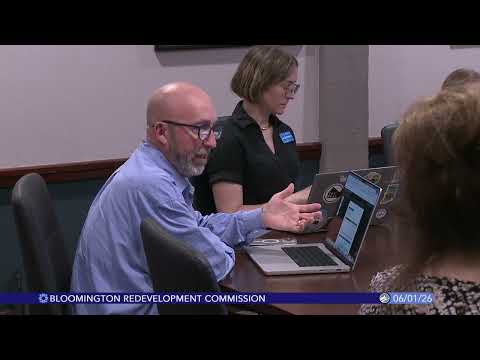
The Redevelopment Commission of Bloomington City on June 1 approved final conditions attached to the Hopewell South planned unit development and authorized staff to pursue the plats and permits necessary to move the project toward construction.
Planning and legal staff outlined council‑imposed “reasonable conditions” that the commission accepted after discussion. The conditions cover formatting of the allowed‑use table, a single‑phase infrastructure approach, sidewalk and tree‑plot cross‑section updates, a 10‑mile‑per‑hour target design for vulnerable road users, and energy‑efficiency requirements for new homes. Anna Jillian Hansen, planning staff, described the energy standard as “homes designed using a preapproved plan model to achieve energy performance equivalent to a home energy rating score of 65 or better,” and said construction documents must include best practices for air sealing and high‑efficiency all‑electric systems.
The most significant policy item concerns affordability. The council negotiated a requirement that at least 35% of Hopewell South dwelling units be permanently affordable, with a goal of 50%. The condition specifies income bands: a minimum of 15% of units reserved for households at or below 90% of area median income (AMI) and a minimum of 20% reserved for households at or below 120% AMI. Hansen acknowledged uncertainty about construction costs but said staff will pursue multiple tools, including potential housing TIF or nonprofit partnerships, to achieve the goal and report back every six months for five years on methods and progress.
Commission discussion focused on implementation risk and wording. Commissioner Laurie (said in chat) proposed clarifying language to state the commission “intends to comply with the conditions to the extent that they can feasibly be accomplished without significantly undermining the goals of the PUD.” Commissioners agreed to the amendment and to include the revised language in the resolution before vote.
Separately, the commission approved a lot‑line adjustment that realigns three historical lots to match the approved PUD layout, enabling early construction of two lots (to be recorded as 148A and 149A) and a remainder parcel; engineering staff said class‑2 building permits could be issued in roughly two weeks after recording. Engineering director Kevin Pinocchio described a schedule that anticipates submitting a primary plat to plan commission in July, then secondary plat and other permits at staff level, with bidding and award to follow; he cautioned that most heavy construction is likely to occur in 2027 given project delays.
The commission gave blanket authorization for staff to submit primary and secondary plats, plat vacation, PUD final plan, site development permits, sanitary sewer and water permits, and the construction stormwater general permit. Staff said they will return to the commission for major milestones and for contract award recommendations. The resolutions on PUD conditions and permitting passed by unanimous roll call.
What happens next: staff will submit the identified permits and return with milestone updates or when an award recommendation is ready. The commission also retained the option to return to council for amendments if specific conditions prove infeasible during implementation.