Get Full Government Meeting Transcripts, Videos, & Alerts Forever!
Get email alerts on the Local History topic
No spam. Unsubscribe anytime.
Northborough historical commission chair details fates of local loyalists in Revolutionary-era presentation
Summary
Bob Light, chair of the Northborough Historical Commission, said identified loyalists in town were disarmed, confined and in some cases had property confiscated and auctioned during the Revolutionary era, citing a 1774 bond petition and the experience of the Eager family.
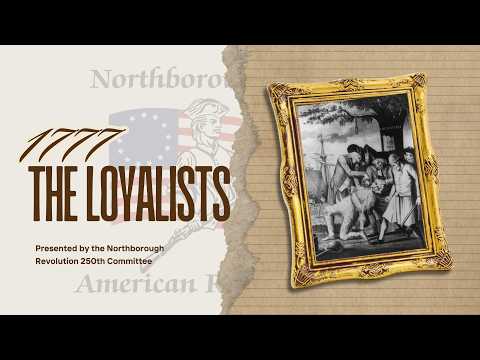
Bob Light, chair of the Northborough Historical Commission, said identified loyalists in Northborough were disarmed, confined to their homes and sometimes had property confiscated during the American Revolution, in a recorded presentation produced as part of the town's 250th commemoration series.
"We will not acknowledge, submit to the pretended authority of any committee of correspondence or other unconstitutional assembly of men," Light quoted from a 1774 "bond of protection" petition he discussed, saying the document urged loyalists to stand with the British crown and to protect their lives and property if necessary.
Light described three political groupings among town residents before open rebellion in 1775: loyalists who professed loyalty to the king; patriots who opposed British rule; and a sizable group of neutral citizens who were later pressured to choose sides. He listed four common reasons colonists remained loyal: fear of anarchy, concern for personal safety and property, economic and professional ties to the empire, and a duty to uphold existing law.
Light recounted the experience of the Eager family as an example of the consequences for some loyalists. He said James Eager Jr.'s widow, Miriam Wheeler, relocated to Nova Scotia; James Eager III and another son, John Eager, had property confiscated and auctioned, and John Eager was jailed before serving with British forces and later becoming a resident of Nova Scotia. Light also described in‑laws whose estates were seized or who were charged by local committees as enemies of the revolutionary cause.
Light said that by June 1777 towns were required to identify loyalists, and that in Northborough those identified were disarmed and confined to their homes. He added that while some loyalists were publicly targeted, others remained unidentified and ultimately accepted the new nation's independence.
The remarks were part of a short video series the historical commission is preparing to mark the Town of Northborough's 250th anniversary of the American Revolution.