Get email alerts on the Homelessness Response topic
No spam. Unsubscribe anytime.
New Marathon County homelessness coordinator outlines short‑term framework, urges better data
Summary
Megan Barnett, Marathon County’s new public health coordinator for homelessness response, presented a short‑term foundational framework through the end of 2026 focused on roles, data, coordinated response and community engagement and called for a real‑time by‑name data system to measure progress.
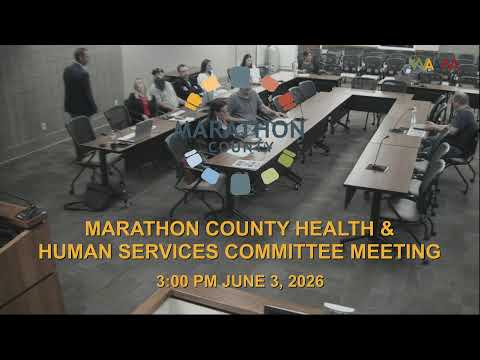
Megan Barnett, Marathon County’s newly hired public health coordinator for homelessness response, told the county Health and Human Services committee that the county lacks reliable, population‑level data on people experiencing homelessness and that a short‑term foundational framework is needed to coordinate services while more precise data is collected.
Barnett, who said she began the role on March 16 and works with colleagues at the Marathon County Health Department and city staff in Wausau, told the committee she met roughly 25–30 community members, agencies and people with lived experience in her first two and a half months. “I did not meet a single person out in the community that could quantify the issue of homelessness for me,” she said, urging the committee to prioritize data collection before setting time‑bound SMART goals.
The foundational framework, Barnett said, will guide county–city coordination through the end of 2026. It centers on four focus areas: roles and leadership, data, coordinated response and community engagement. She recommended a small steering committee led by city and county leadership to formalize responsibilities and said the county and city will jointly invite providers, including emergency shelters, to participate.
Barnett described an aspirational data goal: a real‑time, by‑name tracking system that would reduce duplication, limit stigma and allow service providers to measure progress. “It would be really awesome to have a real time by name data tracking system,” she said, and she set an internal target of having the foundational framework in place through December so staff can develop measurable outcomes and SMART goals thereafter.
Supervisor Rosenberg pressed Barnett on how the county would assess partner organizations such as Bridge Street Mission and hold them accountable for outcomes. Barnett replied that emergency shelters are “part of the solution, but not the sole solution,” said shelters should be invited to the coordination table, and that data collection and ongoing communication with shelter operators are essential to measuring success. She added that the new shelter had been open about six weeks and that staff are in regular contact with its operators.
A county administrator emphasized that clear performance indicators will be needed to know whether interventions are moving the needle, and that the county must clarify its long‑term role in shelter provision: “The county does not see a long term role in the direct or indirect provision of emergency shelter care,” the administrator said, while also stressing where nonprofits and other stakeholders might “plug in.”
Barnett said she plans quarterly updates to the Health and Human Services committee, a joint county‑city meeting at the end of December to present the foundational framework, and subsequent presentations to the full county board and the Wausau common council. She urged the committee to include people with lived experience in engagement sessions across the county.
The committee offered unanimous praise for the presentation. A longtime Marathon County resident who spoke during the meeting thanked Barnett and said improved data collection would help hold partners accountable and track progress.
Next steps: Barnett will continue community outreach, work with staff on data collection plans and return to the committee with quarterly updates; county and city leadership will form a steering committee to formalize roles and work toward a five‑year strategic plan following the foundational framework.
AI generated
The text on this page is AI generated. Summaries, highlights, analysis, and video transcripts are all produced from the original source material.
AI can make mistakes, so if you spot one, and we will fix it for everyone.
Note: the source content is unaltered by us. Any content source we link to, be it a video, an audio recording, or a document, is presented exactly as its publisher released it. That publisher is usually a government body, sometimes an individual official or another organisation.