Get Full Government Meeting Transcripts, Videos, & Alerts Forever!
Get email alerts on the Energy Policy topic
No spam. Unsubscribe anytime.
Administration invokes Defense Production Act to shore up coal plants and mines with $700 million package
Summary
President Trump announced a $700 million federal package and said he was invoking the Defense Production Act to extend the operational life of dozens of coal facilities and mines, protect jobs and build export capacity. Cabinet officials and state governors framed the move as restoring grid reliability.
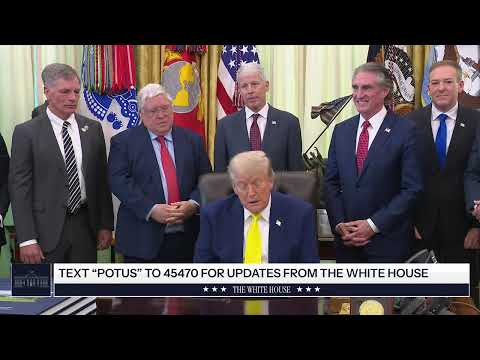
President Trump announced at a White House event that his administration is invoking the Defense Production Act to support U.S. coal infrastructure, saying the action will "protect 14 coal plants and 42 coal mines" and will be backed by a $700,000,000 federal investment.
The president said the package will allow facilities to "invest in upgrades that will extend their operational lives for decades," create two new coal plants and a new export terminal, and support "over 14,000 jobs," remarks echoed by Department of the Interior Secretary Doug Burgum and Department of Energy Secretary Chris Wright. "These actions will support over 14,000 jobs and save the American people $50,000,000,000 in electricity costs," the president said.
Why it matters: The administration cast the move as a response to grid reliability concerns and rising energy costs, framing coal as a dispatchable source needed alongside gas and nuclear. Interior Secretary Doug Burgum said the administration had accelerated leasing and approvals and opened "13,100,000 acres" for potential energy leasing (he said these are not national parks or wildlife refuges). Energy officials said Defense Production Act authority and matching private investment would be used to keep plants operating.
Officials and claims: Burgum described a permissive permitting posture and said metallurgical coal had been designated a critical mineral, which he said "opens up a number of opportunities." Secretary Wright said the administration had used its authorities to keep plants open and prevent the loss of gigawatts of generating capacity, asserting that keeping those plants operating was crucial to avoid grid failures during extreme weather.
What was not established: The announcement included numerical claims that were stated by speakers during the event (numbers of plants, mines, jobs and projected consumer savings). The administration attributed some outcomes to a $700,000,000 federal commitment matched by private investment; the transcript records these figures as assertions by speakers but does not include documentation, contracts, or permitting records in support. Reporters asked follow-up questions during a subsequent Q&A but no independent evidence was provided in the event itself.
Procedure and next steps: President Trump said the moves were being implemented now and credited a recent statute-like authority (Defense Production Act invocation) as the mechanism; he and Cabinet officials described expedited approvals and leasing steps already underway. The announcement did not include a detailed implementation timetable or named contractors for the projects discussed. "We're officially invoking the Defense Production Act to save 13 coal plants," the president said when introducing the policy action.
The administration said the funding would be matched by private investment; Secretary Wright stated the $700,000,000 would be matched with $1,700,000,000 in private investment, according to remarks at the event. Reporters pressed officials during the Q&A about how savings would be passed to consumers; the president responded that the administration's actions would lower costs but did not provide precise consumer-protection mechanisms during the briefing.
The event closed with the president and attendees praising the announcement; the administration said additional project-specific announcements and a separate nuclear-related announcement would follow later.