Get Full Government Meeting Transcripts, Videos, & Alerts Forever!
Get email alerts on the School Budget topic
No spam. Unsubscribe anytime.
Locust Valley board approves revised $99.99 million budget for June 16 revote
Summary
The Locust Valley Central School District Board approved submitting a revised $99,987,243 2026–27 budget for a June 16 revote after a presentation by Karen, who said the plan lowers the proposed tax levy to 1.78% and warned that a second defeat would force a legally required contingency budget cutting extracurriculars, late buses and some community services.
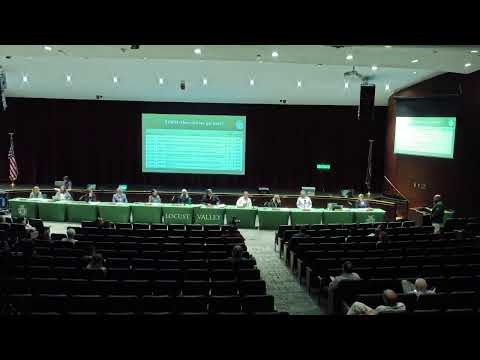
The Locust Valley Central School District Board of Education voted unanimously to approve and submit a revised $99,987,243 budget for the 2026–27 school year for a revote on Tuesday, June 16.
Karen, the district’s budget presenter, said the revised plan reduces the proposed tax-levy increase to 1.78% and “presents a balanced plan that reduces the tax burden while maintaining the core educational programs and safety measures our children rely on.” She told trustees the district lowered total spending to about $99.987 million by trimming business-office contractual expenses, cutting roughly $20,000 each from facilities equipment and professional development lines, and reducing administrator travel and conference costs.
The revision also factors in recent state budget actions, Karen said, including an incremental rise in foundation aid and adjustments tied to UPK funding. Karen reported the district’s nonproperty revenue at about $8.222 million, leaving required property-tax revenue of roughly $91.764 million. Under the district’s calculations, the proposed 1.78% levy sits 1.06 percentage points below the state’s maximum allowable cap of 2.84%, which the presentation said translates to approximately $955,000 in direct taxpayer savings compared with the maximum permitted increase.
Why it matters: Karen warned that if voters again reject the budget on June 16, New York State Education Law requires the district to adopt a contingency budget. She said a contingency budget carries three immediate mandates: a 0% tax-levy increase, spending restricted to ordinary and mandated expenses, and the elimination of noncontingent items. “A contingency budget enforces 3 immediate mandates,” she said, listing examples that would be cut under contingency: elementary clubs and before‑school/after‑school band and orchestra, late buses for extracurricular activities, driver’s‑education classes, the after‑school EMT program, summer academic interventions, some weight‑room upgrades and community recreation programs.
Karen added that outside groups, including parent councils, could use district facilities under contingency only if they fully reimburse 100% of the operating costs (overtime pay, benefits, utilities and an allocation for wear and tear). On senior‑center support, Karen said the district’s annual contribution is about $11,600 and that that funding would be eliminated under contingency; she said she did not have a detailed count of how many people would be affected in the meeting.
Board discussion and questions focused on the specifics of the cuts, multi‑year planning and transportation. Karen told trustees the district had negotiated a favorable five‑year transportation contract with Hendrickson but warned that under a contingency budget the district could only enter single‑year agreements, eliminating planned savings for years 2–5. Trustees asked the administration to prepare longer‑term enrollment and revenue scenarios so the community can weigh “scalpel” versus wider “ax” approaches to future reductions.
Public commenters raised practical concerns. Vanessa Hammer asked whether the items listed for elimination under contingency were certain or could be partially retained; Karen replied that the list reflects legal classifications under state law and therefore would be cut unless the district finds legally allowable exceptions. Steve Minicozzi questioned regional levy averages and asked whether the district has a five‑ or ten‑year plan for projected budget growth; trustees said the administration will develop multi‑year scenarios for review.
The Chair read a resolution approving the revised budget and authorizing submission to the State Education Department; the board set a public hearing on the revised budget for June 8, 2026, and scheduled the budget proposition for the June 16 revote. The motion passed unanimously; a second was recorded as “Holly.”
Next steps: the district will publish the revised property‑tax report card, hold the public hearing on 2026‑06‑08, and present the proposition to voters on 2026‑06‑16. The board also approved a consent agenda authorizing approximately $30,000 in expenditures to run the revote election.