Get Full Government Meeting Transcripts, Videos, & Alerts Forever!
Get email alerts on the Education Budget topic
No spam. Unsubscribe anytime.
PGCPS work group urges county council to add $30M, outlines revenue and transportation options
Summary
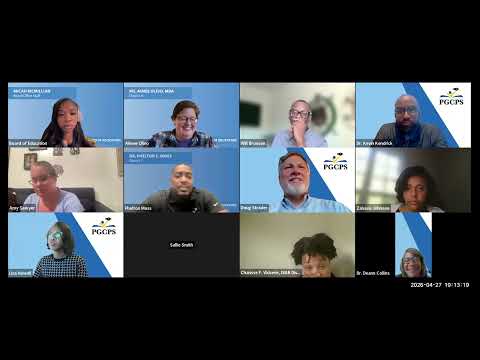
A Prince George's County Public Schools work group on April 27 urged residents to press the County Council to add $30 million to fully fund the district's $50 million supplemental request and reported subcommittee proposals — from Medicaid revenue strategies to transportation opt-in surveys — to close the remaining budget gap.
A Prince George's County Public Schools (PGCPS) strategic realignment work group on April 27 urged residents to press the County Council to add $30,000,000 to the county executive's proposal to reach the district's full $50,000,000 supplemental request, and outlined several revenue and transportation options to help close the remaining budget shortfall.
Vice Chair Amy Olivo, vice chair of policy and governance, told the work group that the board's budget approval was only “the first step in a very long process,” and urged participants to testify at the council's upcoming hearings and to email council members. "We're asking them to add in $30,000,000 to fully fund our budget request, for fiscal year 27," Olivo said, and said she would circulate sign-up instructions for oral testimony and guidance on the council's written-comment process.
Why it matters: The council must approve a final budget before the statutory deadline; district leaders said substantial portions of the unfunded request are directed toward special education and other mandated services. Superintendent Joseph told the group that "of that $33,000,000 that wasn't funded yet, 27,000,000 of those dollars... [are] dedicated to special education," and stressed urgency for family advocacy as the council reviews proposals.
Subcommittee findings: revenue and transportation
The meeting divided into three subcommittees — fiscal review and resource alignment; revenue and sustainability; and stakeholder engagement — then reconvened for brief reports. The fiscal/revenue group recommended staff meet with the district's Medicaid revenue team and explore the federal "Katie Beckett" waiver as a possible way to capture Medicaid reimbursement for eligible special-needs students. "It allows... children who have special needs regardless of income to also have Medicaid," Charice Vickery said, noting that increased enrollment and billing could generate revenue for student services.
The revenue and sustainability subgroup raised a range of creative, non-tax ideas to supplement district income: revisiting whether gambling-related commitments and ticket revenues tied to the MGM partnership are reaching education programs, pursuing stadium sponsorships and alumni-donation models, expanding bus and facility-use fees, cultivating philanthropic partners, and applying for targeted grants (for bilingual instruction, CTE expansion and other program-specific funding). Chief Strader summarized those proposals as a starting list for further analysis and recommended tracking where existing funds are currently spent before proposing new allocations.
The stakeholder-engagement group focused on how to collect timely, representative feedback between now and mid-June. Dr. Kendrick said the group brainstormed which audiences (families, educators, community leaders) need which facts, and discussed using surveys and targeted outreach to specialty-program parents to test support for changes such as an opt-in transportation model or increased use of public transit for older students.
Clarifications on the county executive's commitment
Chief Howell, the district's finance chief, told the work group the county executive's verbal reference to $20,000,000 had not been reflected in the formal packet transmitted to the County Council. "The county executive, while she verbally committed to an additional $20,000,000, it was not reflected in the request sent to the county council," Howell said, which left the council with the district's original $50,000,000 request to consider.
What comes next
Olivo urged members and residents to register early for the council's public comment periods (noting registration quirks and an in-person testimony rule), and said the second night of hearings — May 11 — is a last scheduled opportunity to speak directly. The board expects to vote on a final budget in June; in the meantime, subcommittees will continue modeling options and staff will provide materials and sign-up instructions.
The meeting closed with the chair reiterating the expectation of robust public turnout at the council hearings and a commitment from committee leads to follow up with members before the next work-group meeting.