Get Full Government Meeting Transcripts, Videos, & Alerts Forever!
Get email alerts on the Beach Signs topic
No spam. Unsubscribe anytime.
St. Pete Beach workshop narrows focus on keeping signs off wet sand while weighing customary‑use claims
Summary
City staff, residents and hoteliers debated emergency sign rules and alternatives at a St. Pete Beach workshop, broadly agreeing that metal posts in the wet sand should be avoided and directing staff to refine ordinance language ahead of upcoming readings.
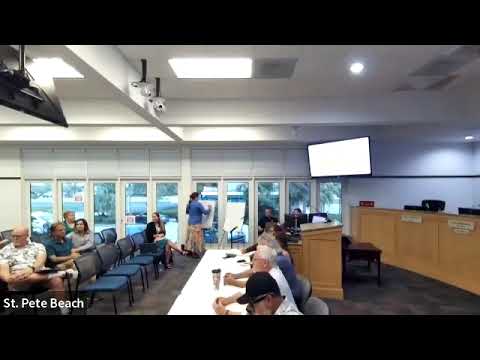
City officials and dozens of residents met at a St. Pete Beach workshop to discuss an emergency sign ordinance that bars nongovernmental signs, posts and poles close to the water and to gather community feedback on possible changes before a formal second reading.
"We have 60 days to take action on second reading or the emergency ordinance goes away," the city manager, Francis, told the room as staff outlined the purpose of the session: craft enforceable, less intrusive rules that balance private-property interests with longstanding public beach use.
The emergency ordinance staff described temporarily amended the land‑development code to prohibit nongovernmental signs within 50 feet landward of the mean high‑water line and allowed only official government signs as exceptions. Staff proposed measuring from a visible waterline (easier for officers to locate), a permit process requiring property surveys, and permitting only removable signs that must be taken down daily or at sunset so markers are not left permanently in the sand.
Hotel and business representatives urged measures that enable enforcement and limit liability. "You can't enforce liability issues without signs, and that's direct from the sheriff," Melanie Vandegrift, representing a local resort, said, arguing that hotels need a clear way to show officials where private property begins.
Many residents pushed back on any rule that would allow metal posts or parking‑style signs in the wet sand. "They're ugly, but it's also dangerous," longtime resident Vince Sullivan said of metal posts placed near the waterline, describing incidents where posts floated loose or posed a hazard to early‑morning walkers.
Speakers debated how to prove property boundaries in the field. Some property owners favored surveys and visible corner markers; others — including commissioners and the city attorney — said deeds and title searches can reveal easements or public‑use exceptions that surveys alone do not show. That tension underpinned much of the discussion about whether the city should require property owners to provide title evidence or only surveys to obtain a sign permit.
The legal context for the debate centered on Florida's customary‑use doctrine. The city attorney summarized the doctrine as a common‑law defense to trespass: certain public uses of the dry sand and foreshore that have been ancient, reasonable and uninterrupted may give the public rights that cannot be extinguished solely by private signage. "Just because you put a flag up doesn't mean the public can't continue to walk across the area," the city attorney said, urging caution in adopting rules that could unintentionally alter customary access.
Participants offered alternatives to metal posts: small corner buoys, low‑profile flags, planting lines of palm trees or other aesthetic markers, and technical solutions such as GPS coordinates or passive beacons that officers could use to verify parcel corners without visual posts in the surf. Commissioners and staff also discussed limiting the number and style of permitted signs so properties do not pepper the beach with markers.
Several speakers said the sheriff's office needs explicit notice to enforce trespass claims; staff summarized that deputies generally rely on visible notice or an ability to verify private boundaries before directing removal. That practical policing constraint helped explain property owners' desire for some type of delineation even as many residents urged solutions that avoid changing the character of the shoreline.
What emerged was a narrow set of points with broad agreement: avoid permanent metal posts in the wet sand, keep signage back from the waterline so it does not interfere with beachgoers, explore less intrusive or more aesthetic options, and obtain a clear legal memo about how any sign rules would interact with customary‑use rights. Staff said the updated beach ordinances will be presented for first reading on June 9, with a second reading currently scheduled for June 23; the city also announced a seminar on customary use law for July 23.
The workshop ended with staff asking for any final suggestions and promising to bring the feedback — including specific ideas about sign design, permitted locations, surveying and possible technical markers — to the city attorney for ordinance drafting and a legal opinion to be shared with commissioners and the public.