Get Full Government Meeting Transcripts, Videos, & Alerts Forever!
Get email alerts on the Private Streets topic
No spam. Unsubscribe anytime.
Council declines to approve Veil Avenue conversion after hours of public comment; orders study of obstruction removal
Summary
After more than an hour of public testimony from neighbors worried about a roughly $14,000 assessment, the Worcester City Council declined to adopt a committee recommendation to convert Veil Avenue from a private way to a public street and instead voted to request a city report on removing a roadway obstruction and the cost of reconnecting the street.
Vice Chair Christian King opened a late-night debate after dozens of residents and callers testified about agenda item 19a, a proposal to convert Veil Avenue and adjoining blocks from a private way to a public street. Speakers clustered on opposite sides: some called the work a necessary public-safety move, while many abutters said the assessment would be unaffordable.
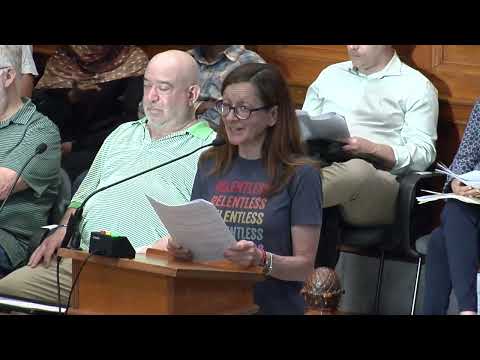
"It would be a huge financial hardship for me," Melinda Martin, a paraeducator with Worcester Public Schools, told the council, estimating about $14,000 per homeowner if the city moves forward. Multiple residents echoed that concern and said they bought homes on private ways specifically for safety and the dead-end character of the street.
Councilor Satya Mitra, sponsor of the order and a member of the public-works committee, framed the proposal as a safety measure. "I think safety was the first thing in my mind," Mitra said, noting the street's condition and the risk that emergency vehicles could be delayed if the roadway is not publicly maintained. Mitra also asked the city to study whether extending finance terms to 35 years would make assessments more affordable.
City Manager Eric Batiste and Assistant Commissioner Mello presented engineering findings. Mello described "alligator cracking" and drainage failures on the roadway and said the city’s matrix gave the road a priority-1 rating. He added that partial interventions — removing an obstruction (a tree) to connect the roadway, installing speed tables, or adding sidewalks — could address the principal public-safety concerns without full conversion.
On procedure, councilors debated whether to recommit the item to the standing committee or vote immediately. A motion to recommit (to send back to the committee) resulted in a 5–5 tie and failed. A roll call to adopt the public-works committee recommendation to convert the road produced only two yes votes and the committee recommendation failed to carry.
After those votes, the council approved, by roll call, a separate request that the city engineer and administration study removal of the obstruction and the cost to connect the roadway "as a minimum in the interest of public safety." That motion passed with broad support.
The council did not adopt the conversion order. The chair then moved to recess, take finance items, and reconvene; remaining conversion-related items were postponed for future meetings.
What happens next: Council requested a written report from the administration on (1) the feasibility and cost of removing the obstruction/tree and reconnecting the road, and (2) the financial implications of a 35-year payment option for abutter assessments. The matter may return to the standing committee or to a future council meeting for further action.