Get Full Government Meeting Transcripts, Videos, & Alerts Forever!
Get email alerts on the Community Survey topic
No spam. Unsubscribe anytime.
Wyoming council approves phone survey vendor after debate over method and representativeness
Summary
After public comments and council questions about sampling and response bias, Wyoming City Council voted to accept a proposal for a phone‑based community survey that guarantees 1,000 completed responses and includes Spanish‑language capability. Council members emphasized the need to work with staff on question design and outreach.
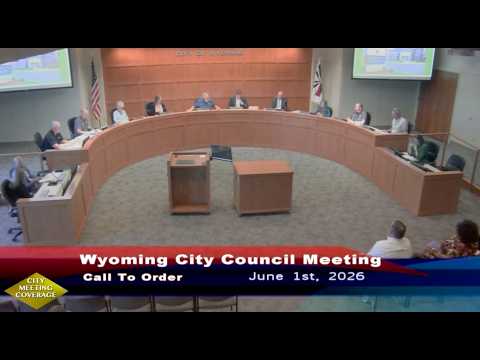
Wyoming City Council on June 1 approved a contract proposal for a community survey that will aim to collect 1,000 completed responses by telephone, including landlines and cell phones, with Spanish‑language administration available.
City staff said the vendor will attempt calls until it achieves 1,000 completed interviews and will weight results to reflect the city's demographic profile by ward, age, income and race. John (city staff) told the council the firm can provide breakdowns “by ward, by area of the city, by demographics” so the council can see differences in priorities across neighborhoods.
The motion to accept the proposal followed public comment from resident Karen Francois, who urged the council to consider mailed letters or an online survey instead of phone calls, arguing that many residents screen unknown numbers and that long calls risk a non‑representative sample. “Getting people to actually answer their phones — particularly cell phones — is hard,” Francois said, adding voters who complete 16–18 minute surveys may not reflect the broader population.
Council members pressed staff on the survey design, sample weighting and past experience. Staff recalled a prior online survey in 2019–20 that received just 262 responses when mailed or online options were used, and said the proposed phone approach was chosen because it provides verifiable addresses and the vendor will stratify the sample to mirror community demographics.
Several council members asked for more qualitative, open‑ended questions to capture nuance; staff said the city would work with council or an ad hoc group to develop the final question set. Council agreed that pre‑notifications and marketing would help residents recognize legitimate calls.
The council approved the proposal in a roll call vote: Yes — Brethauer, Arnois, Postema, Hosler and the Mayor; No — de Krieger and Hill.
Next steps: staff will finalize the question list with the vendor and report back on any changes to timing or costs if the vendor requires a shorter execution window.