Get Full Government Meeting Transcripts, Videos, & Alerts Forever!
Get email alerts on the Land Use topic
No spam. Unsubscribe anytime.
Planning & Zoning Commission recommends denial of Cape Baptist Church land-use change after tower, neighborhood concerns
Summary
At its June 3 meeting, Cape Coral City Planning & Zoning Commission voted 5-2 to recommend denial of a privately initiated future land use map amendment that would have reclassified about 4.52 acres used by Cape Baptist Church from single-family to public facility amid resident objections about a proposed 148-foot communications tower, traffic and privacy impacts.
At its June 3 meeting, the Cape Coral City Planning & Zoning Commission voted 5-2 to recommend denial of ordinance 28-26, a privately initiated future land use map amendment for three parcels totaling about 197,044 square feet (roughly 4.52 acres) currently used by Cape Baptist Church.
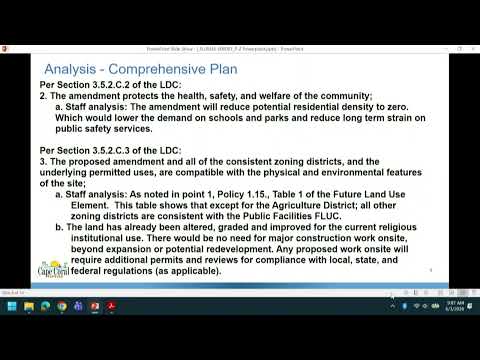
Staff planner Candace Ford told the commission the applicant seeks to change the sites from single-family residential (R-1) to public facility to align land-use classification with the church’s existing use. Staff analysis concluded the change would reduce potential residential density (from up to 19 dwelling units to 0), produce minor increases in peak-hour vehicle trips, and require routine permit reviews for any future construction; staff recommended approval.
Linda Miller, vice president of Avalon Engineering and the applicant’s representative, said the amendment would permit expansion of the religious facility and could support a future communications tower to expand the church’s radio outreach, True Hope Media. “Our request is to amend the future land use map from single family residential to public facility,” Miller said, adding that the property has been used by Cape Baptist Church since 2010 and that any tower or building expansion would require separate rezoning and site-development review.
Several neighbors urged the commission to deny the map change. Linda Colleen Simon, a nearby homeowners-group leader, said a land-use designation “stays with the land,” warning that the public-facility label could permit future uses beyond a church and that an FCC/FAA application showed a proposed 148-foot tower. “There’s a huge amount of possibilities versus what it is now,” Simon said, citing concerns about traffic, lighting and radio-frequency exposure.
Adjacent homeowner Abeer Madanat said the church’s preliminary site plan looked “like it’s about to be a parking lot for a mega church and a tower,” and pleaded for privacy protections such as fencing or landscaping. “I don’t have any privacy now,” Madanat said, describing worries about construction dust, noise and possible property-value impacts. Karen Ramos, another neighbor, also singled out the tower and RF concerns and asked whether the land could be sold later and redeveloped for denser uses.
Commission discussion focused on process and scope. Commissioner Martin noted the commission was deciding only a land-use designation, not permitting construction, but said he had “a hard time thinking the city would allow a tower in there” and recommended buffering if the project moved forward. Commissioner Estes pressed staff and the applicant on whether a FLUM approval would vest rights for a tower; staff and the applicant said any wireless facility would require a subsequent zoning change, site plan review and the wireless facility packet required by the land development code.
After discussion, a motion to recommend denial of ordinance 28-26 carried on roll call, five in favor and two opposed. That recommendation will be forwarded to City Council for final action.
The commission record includes staff’s technical estimates: water and sewer use projections tied to the proposed public-facilities designation, a projected drop in allowed resident population on the site (from an estimated 48 people under R-1 to 0 under public facilities), and an anticipated small increase in police and fire service calls. Staff also noted two resident emails and one caller in opposition received before the hearing.
The council will receive the commission’s recommendation and may hold its own public hearing before taking final action.