Get Full Government Meeting Transcripts, Videos, & Alerts Forever!
Get email alerts on the Municipal Budget topic
No spam. Unsubscribe anytime.
Hickory City Council unanimously approves recommended $162.7 million FY 2026-27 budget
Summary
After a public hearing with no speakers, the Hickory City Council approved the city manager's recommended FY 2026-27 budget, endorsing targeted spending increases for street resurfacing, sidewalks and water/sewer infrastructure and a $1 monthly solid-waste fee rise to make that fund self-supporting.
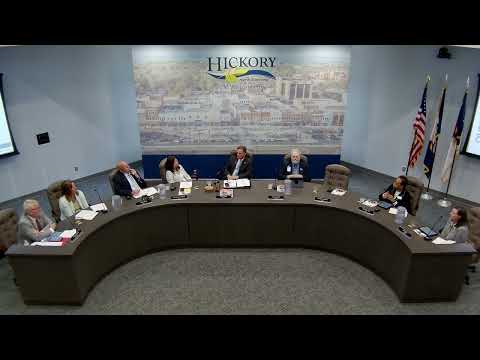
Hickory City Council on June 2 approved the city manager's recommended fiscal year 2026-27 budget after a public hearing at which no one testified for or against the plan.
City Manager Warren Wood presented the recommended annual budget, describing roughly $162.7 million in total activity for the coming year and an operating-budget increase of about 2.3% over the prior year. "Your annual budget... is what it means, 1 year, July 1 to June 30," Wood said while reviewing core services and fund totals.
Wood told the council that core city services—or police, fire, streets and traffic, solid waste, water and sewer and debt service ccount for roughly $107 million and about 77% of the operating budget. He said the general fund is approximately $83 million and the recommended water and sewer fund budget is about $44 million.
The council endorsed several targeted changes in the recommended plan: a one-time increase in the street-resurfacing appropriation from $1 million to $2 million this year with a long-term target of $4 million; an increase in the sidewalk budget from $200,000 to $500,000 (with the additional $300,000 drawn from capital-reserve interest); and the continued evaluation of water-system resiliency projects, including a potential second raw-water intake and additional storage capacity. Wood said the evaluation of second-intake options will take roughly 18 months, followed by multiyear permitting and construction processes.
On utilities, Wood outlined a proposal to move toward a more conservation-based water/sewer rate structure in FY 2027-28 paired with advanced metering infrastructure (AMI). He said the change would shift more of the cost burden to larger-volume users and that the transition should not jeopardize the city's bond ratings.
The recommended budget also includes a modest adjustment to solid-waste fees: "We're recommending going from $29 to $30 a month," Wood said, noting that the change would make the solid-waste fund self-supporting for the first time in three decades. He framed the change as an operational adjustment to cover personnel and equipment costs in that fund.
Wood highlighted ongoing and upcoming capital projects funded outside the annual operating budget, including the multi-year $3 million Springs Road project, park improvements (including design for a Catawba River Environmental Education Center and work at Buggytner Park), trail connectors and federally funded airport infrastructure projects. He said the city has leveraged roughly $227 million in grant awards over the last decade to support bond-program projects.
Mayor Giss opened the public hearing on the recommended budget and allowed the scheduled opportunities for opposition and support; no members of the public spoke. After the hearing was closed, the mayor moved to approve the recommended budget. The motion received a second and carried unanimously.
The council also discussed fund balance policy during the meeting; Wood said the city follows a conservative budgeting approach with a target fund balance of 25% and estimated the city's actual fund balance to be about 34%.
The council's vote concluded the public hearing and approved the recommended budget as presented by City Manager Warren Wood.