Get Full Government Meeting Transcripts, Videos, & Alerts Forever!
Get email alerts on the Urban Renewal topic
No spam. Unsubscribe anytime.
Wilsonville council backs using revised town center feasibility study as basis for November ballot measure
Summary
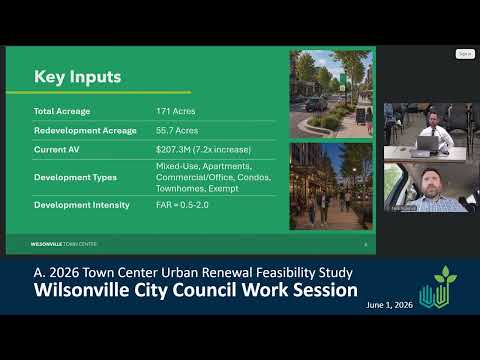
After a detailed staff presentation and lengthy council debate, councilors signaled support June 1 to use a revised urban renewal feasibility study as the basis for a potential November 2026 ballot measure and directed staff to start drafting ballot-title language, while several members voiced reservations about assumptions and residential counts.
Wilsonville's mayor and a majority of the city council on June 1 backed using a revised Town Center Urban Renewal Feasibility Study as the basis for a possible November 2026 ballot measure and asked staff to begin drafting the ballot-title language.
The study, presented by Matt Lorenz, the city's economic development manager, updates a 2023 feasibility analysis and adjusts assumptions about redevelopment acreage, floor area ratios and residential unit sizes. Lorenz said the current model projects roughly 2,381 residential units and about 1.1 million square feet of commercial space under the modeled redevelopment scenario. He also outlined maximum indebtedness and disclosure numbers: "$92.3 million" in 2027 dollars for maximum indebtedness and a $164 million figure for public disclosures after adjusting for inflation and Measure 3632 requirements, he said.
The matters before council were limited: confirm that the revised feasibility study should serve as the basis for a potential November ballot measure, and, if so, direct staff to begin drafting the ballot title. Lorenz framed the issue as a financing tool: "These are the two items staff is looking for guidance on this evening," he said.
Councilors asked detailed questions about the study's inputs: why residential unit counts fell from earlier estimates, how floor area ratios translate to building height, and how the study models "but-for" growth versus baseline appreciation. Consultant Nick Popanuk and Lorenz explained that a 10% reduction in redevelopment acreage combined with updated unit-size assumptions and a change in mix between residential types produce a lower unit count than earlier planning documents.
Lorenz cautioned against portraying tax-increment financing as "free money," explaining the concept of foregone revenues: "I think it's unhelpful for proponents of urban renewal to act as if this is free money," he said, and added that some of the taxes captured as TIF may represent new value that would not have existed without urban renewal investments.
Several councilors said they understood the legal and timeline constraints. Mayor O'Neil noted state deadlines and the difficulty of substantially changing the underlying town center plan without triggering complicated updates; he argued that letting voters decide this November was appropriate. Councilor Cunningham said she remained concerned that the revised numbers stray far from community expectations and warned that the presentation might not win voter support, but she did not block moving forward.
After discussion, the mayor asked whether the council would confirm the study as the basis for a ballot measure and direct staff to draft the ballot language. A majority of councilors voiced support, while recording their reservations. Lorenz said staff had what they needed to proceed.
What happens next: staff will draft proposed ballot language and follow the public-notice, outreach and legal review processes required for placement on the November ballot. The council did not adopt financing documents or ordinances at the meeting; the action was a direction for staff to prepare materials for future council review.