Get Full Government Meeting Transcripts, Videos, & Alerts Forever!
Get email alerts on the Capital Plan topic
No spam. Unsubscribe anytime.
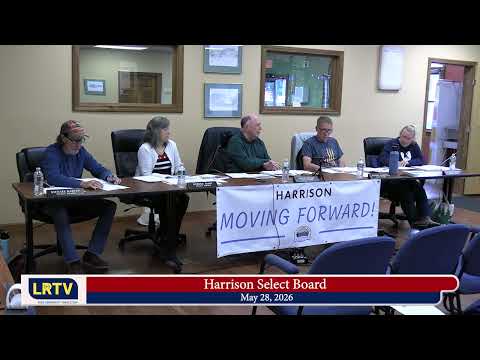
Harrison board debates five-year capital plan, flags roads funding and salt-shed options
Summary
The Harrison Select Board reviewed a draft five-year capital improvement plan that keeps an annual $610,000 line for capital roads, assumes $500,000 in grant funding for specific crossings in 2027, and retains a bond option for a salt/sand shed; the board scheduled further workshops to refine priorities before town meeting.
The Harrison Select Board on May 28 reviewed a draft five-year capital improvement plan that keeps a single annual ‘‘capital roads’’ allocation and relies on a mix of taxes, grants and reserves to fund large projects over the next five years.
John, the town manager, told the board the draft simplifies individual road listings into a single line of $610,000 per year for capital roads after 2027 and retains larger ticket items — notably a salt/sand shed — under a conservative, bond-funded scenario. "If you see to the right, the reserve balance, we had a very aggressive paving projection and we had to do something to try and make this work," John said. He added the plan currently assumes $500,000 in secured grant funding for crossings in 2027.
Why it matters: the plan reshapes how the town sequences paving and other capital projects, balancing limited reserve funds against several high-cost needs. John said the draft treats some projects as contingent on grant awards and noted a $900,000 item that would be bonded in scenarios that change the town's annual payments in 2029–2031.
Board members pressed for more granular data to prioritize work. Several members asked staff to use pavement-management software and road-segment mileage to identify the most critical ‘‘red’’ segments and to rerun assessments before the final CIP. One member said they worried $610,000 a year may not be enough to prevent the town from falling further behind on maintenance; another argued the number was a reasonable, conservative starting point.
Pavement and project sequencing emerged as central choices. John said the draft is intentionally conservative and could be adjusted if the town secures additional grant revenue or identifies lower-cost repair options. "That essentially would free up a couple 100,000 a year from 2029 through 2031," he said of potential grant or cost-saving changes. The board agreed to schedule a workshop this summer to revisit priorities and refine the plan before formally recommending items for the town-meeting warrant.
Also discussed: the feasibility of repairing rather than replacing an existing salt/sand shed, which would require sign-off from engineers and possibly the town’s insurer. John said he would consult the engineers to determine whether repairs could be certified as safe and effective.
Next steps: staff will refine the CIP with more granular road-condition data, follow up with engineers about the salt/shed options, and present a refined packet and the warrant handouts for board review at next week’s meeting. The board expects a fuller public presentation ahead of town meeting.