Get Full Government Meeting Transcripts, Videos, & Alerts Forever!
Get email alerts on the Zoning Net Residential Acreage topic
No spam. Unsubscribe anytime.
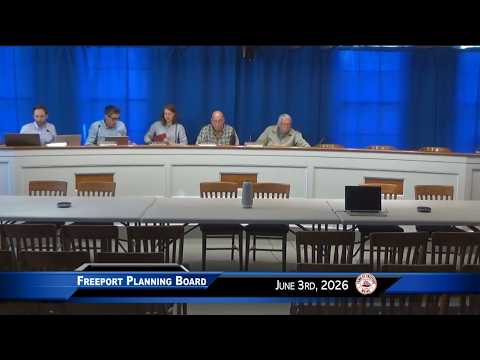
Freeport planning board to advance change removing parking from net residential acreage
Summary
The Freeport Planning Board agreed to ask staff to draft a zoning text amendment that would stop subtracting planned parking areas from net residential acreage for subdivisions, a change staff says could allow substantially more housing units on some sites and will be scheduled for public hearing next month.
The Freeport Planning Board on June 3 directed staff to prepare a draft zoning text amendment that would remove planned parking areas inside multifamily developments from the list of features subtracted when calculating net residential acreage.
The Chair opened the agenda item and explained the proposed change would "remove parking areas that are within multifamily developments, from the list of features subtracted out of the total parcel acreage." A staff member told the board the amendment was prompted by recent downtown C‑1 zoning changes that encourage multifamily development but leave single‑building projects treated differently than subdivisions.
The staff member said the change is intended as a relatively small, implementable fix rather than a wholesale rewrite of density metrics: "The same size site could go from, you know, leaving it as ... you go from 40 something units allowed to 60 something units allowed by changing it." He emphasized that removing parking from the subtraction would not eliminate parking requirements.
Staff explained the technical rationale: when a net residential acreage calculation applies to subdivisions it typically subtracts features that are not buildable — wetlands, steep slopes, or new road rights‑of‑way. Planned parking, by contrast, is buildable land and could later be redeveloped; counting it as buildable acreage better reflects long‑term development potential, staff said. The board discussed distinctions between frontage roads (which create rights‑of‑way that are subtracted) and internal access driveways in condominium or HOA configurations (which typically are not subtracted).
Board members raised broader policy questions about whether the town should move to gross residential acreage across the code, particularly in rural growth areas where removing deductions could increase density on some lots. Staff said that larger, town‑wide changes would require a significant ordinance rewrite and further analysis, and framed this amendment as a "bite‑sized" step that could be implemented more quickly.
With no objections from the board, staff told members, "So we'll bring it forward next month for hearing," directing the office to prepare a draft amendment and schedule a public hearing at the next meeting.
Next steps: staff will draft the amendment language and the Planning Board will hold a public hearing at its next scheduled meeting; no formal vote on the amendment was recorded on June 3.