Get Full Government Meeting Transcripts, Videos, & Alerts Forever!
Get email alerts on the Land Use Classification topic
No spam. Unsubscribe anytime.
Wythe County planning commission schedules June 22 work session to review land-use ordinance after public feedback
Summary
After public comments and staff review, the Wythe County Planning Commission agreed to recess and hold a dedicated work session on June 22 to compile and consider revisions to a proposed land-use classification ordinance; resident Andy Kegley urged banning data centers outside Progress Park and simplifying mapping designations.
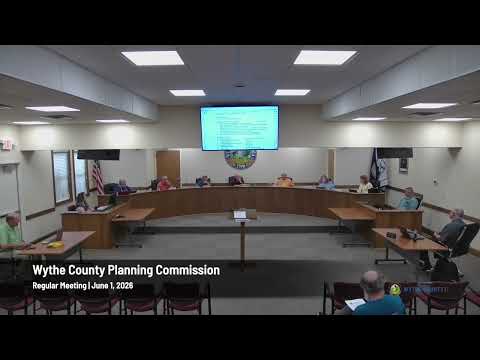
The Wythe County Planning Commission voted to recess the June 1 meeting and hold a work session on June 22, 2026, to review compiled public comments and possible edits to a proposed land‑use classification ordinance. The commission’s staff told members they had received roughly 30–40 responses in various forms and would distribute a spreadsheet of comments and suggested changes by the end of the week.
Deputy County Administrator Hankins said the Board of Supervisors had referred the ordinance back to the commission for further consideration and asked whether the commission wanted to include changes raised in public conversations. Hankins said staff would compile the input and present it for focused discussion: “If possible, could we get those from you by Friday of this week? Absolutely. By email,” he told the commission.
The ordinance has drawn public attention on several fronts. During the Citizens Time segment, resident Andy Kegley urged the commission to ban data centers from commercial and industrial districts outside Progress Park and to remove the transportation‑corridor designation from the map. “I just wanted to reiterate a couple things…that no data centers be allowed in commercial or industrial districts, industrial district outside of Progress Park,” Kegley said. He also argued that the purpose of zoning procedures was to ensure public hearings: “What you really mean is if you're against zoning…you're against the opportunity for a public hearing,” he told the commission.
Commissioners and staff discussed mapping cleanup and straightforward revisions — for example, where one side of a road is mapped agricultural and the other side commercial — and staff said those property‑specific fixes would be among the easier items to resolve. Staff also noted the possibility of a joint meeting with the Board of Supervisors after the commission’s work session so both bodies could reconcile recommendations. “We do want to make sure we don’t drag our feet on this…not months and months,” Hankins said, summarizing the board’s direction.
On state policy, Hankins told the commission that recent house bills affecting solar development were pared back but now require localities to report solar farm decisions to the State Corporation Commission; staff said guidance on the reporting process had not yet been released. That directive may affect how the commission frames solar‑related classifications in the ordinance.
The commission reached consensus to recess the meeting and continue as a work session on June 22 at 6:00 p.m.; the motion passed by voice/consensus in the meeting transcript (vote tally not specified). Staff will circulate the compiled comments before that session so commissioners can prepare.
The work session will focus on mapping corrections, language edits raised during public comment, and how the commission will route any recommendations to the Board of Supervisors and the State Corporation Commission reporting process if relevant.