Get Full Government Meeting Transcripts, Videos, & Alerts Forever!
Get email alerts on the Genetic Ancestry Pilot topic
No spam. Unsubscribe anytime.
Dr. David outlines Illinois pilot's DNA tools, contract extended to June 2027
Summary
A researcher leading the TICARE/African kinship reunion described new features — relative lists, connection maps and automated tree inference — and said the project's contract has been extended through June 2027. Residents raised questions about delayed results and data filters; a fall 2026 public event was tentatively planned.
Dr. David, the lead researcher for the TICARE (African kinship reunion) project, told Evanston residents that the Illinois Family Roots pilot is continuing and the contract was extended through June 2027 to allow more testing and analysis.
"The new end date is June 2027 for the contract," Dr. David said, adding the team hopes to test roughly another thousand people in Illinois and continue the broader TICARE research program.
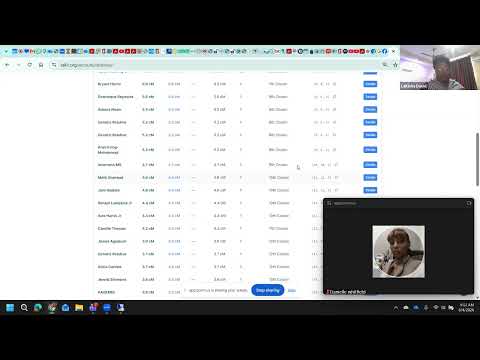
The presentation walked through new features on the project's dashboard. Dr. David demonstrated the relative list (a database of people who have tested in the program), explained how centimorgan totals and the largest shared segment help estimate genealogical relationships, and showed a connection map that visualizes how relatives link to each other. He described a two-pass approach to inference — pairwise matching followed by automated family-tree placement that reports how many generations a given person is from a shared ancestor.
"It's an estimate," Dr. David said of generation inference, noting that for older participants a result of about four generations can reach into the era of mass human trafficking and U.S. slavery. He also cautioned that smaller segments can fluctuate: "If it's at least 15 centimorgans or more, just go — you can go with it," he said, while the project uses a temporary minimum display threshold around 7 centimorgans and plans triangulation methods to stabilize lower-confidence matches.
Dr. David described technical differences between TICARE and common consumer services, saying the project's array tests about 1,800,000 markers compared with roughly 500,000–700,000 on many commercial tests. "So our results are more refined," he said, adding that the project currently keeps uploaded consumer profiles separate from profiles generated by in‑project testing to avoid large-scale statistical estimation across platforms.
Residents used the Q&A to press for specific fixes and user support. Kimberly Fraser said she took a kit nearly three years ago at a Juneteenth event and still had not received results; Dr. David acknowledged the delay, said testing operations were interrupted for a period, and asked participants with missing results to open a support ticket or call project customer service (phone support hours were given as 11 a.m.–3 p.m., Monday–Thursday). "We have customer service hours that you can actually call and speak to a person to help with the situation," he said.
Other questions focused on data filters and interoperability. Participant Sindona asked whether the platform shows which side of the family (mother or father) a match is on; Dr. David said interchromosomal phasing can indicate parent-side for some profiles and that the system displays parent1/parent2 metadata when available. He also said the team plans to accept GEDCOM uploads in a later phase so users who built family trees on services such as Ancestry can port structured tree files into TICARE once that import feature is live.
Dr. David said he was in Ghana to add about 160 Ghanaian testers to the database and that the team will return results to relatives in Cape Coast and Paga at planned community events. He and organizers discussed a tentative public results event likely in September 2026 (with February 2027 as a fallback) to highlight high-confidence diaspora–Ghana matches and personal stories.
The meeting closed with an update that Evanston's reparations-related programs have disbursed more than $7 million in indirect benefits; organizers said they would share information about the pilot and the planned event through the local newsletter and the city website.
Next steps the presenter identified include stabilizing low-confidence matches via triangulation, adding user-import (GEDCOM) support, improving filters (for example, by state or region when testers provide that data), and completing planned outreach events in West Africa to return results to tested relatives.