Get Full Government Meeting Transcripts, Videos, & Alerts Forever!
Get email alerts on the County Budget topic
No spam. Unsubscribe anytime.
Queen Anne's County unveils $231 million FY2027 budget; residents urge more school supports
Summary
County Administrator Todd Mahn presented a proposed FY2027 operating and capital budget totaling about $231 million, highlighting increased funding for schools and a seventh EMS unit; public commenters pressed for more reading specialists, behavioral-health staff and fixes to school facilities.
County Administrator Todd Mahn presented the Queen Anne's County commissioners' proposed fiscal 2027 operating and capital budget on the evening the board met, putting the total next-year plan at about $231,000,000 and describing a roughly 10.3% increase over FY2026.
Mahn told the commission the county expects income-tax revenue to grow about 13.8% and property-tax revenue to rise roughly 10% compared with FY2025 actuals, and that short-term rental permitting will add an estimated $100,000 in revenue. He said the county is proposing to hold the income-tax rate at 3.2% and lower the property-tax rate by three cents per $100 of assessed value for FY2027.
The presentation highlighted an operations-side increase in education funding: the county plans to fund the public school system at $91,400,000 for FY2027, which Mahn said is $8,900,000 above the required maintenance of effort. Mahn also said state funding for FY2027 is projected at $45,000,000, “about 3 and a half million dollars less than they originally forecasted,” which the administration described as part of a longer-term shortfall in state support.
Mahn identified several operational and staffing additions in the proposed plan: funding for a seventh emergency-medical-services unit (he said the unit carries about $1,200,000 per year in related costs), 16 new county positions (including EMS staffing, a jury commissioner and other roles), a 3% cost-of-living allowance and pay-for-performance funding, and a $4,400,000 transfer from operating to capital.
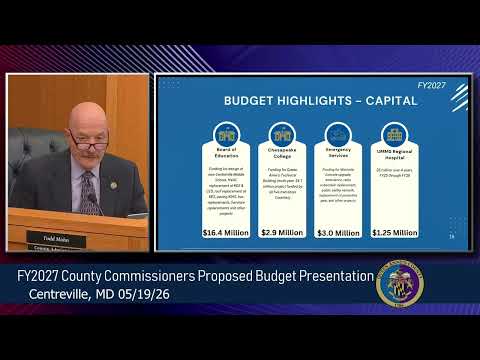
On capital, Mahn outlined roughly $16.4 million in school-related capital projects (including roof work and building replacements) and said the FY2027 capital program totals about $63,500,000 with a mix of state grants, bonds, capital balances and loans. Major capital allocations he listed included support for a regional hospital project, $2.9 million toward the Queen Anne's Technology Center at Chesapeake College and multiple sewer, roads and parks projects.
Public commenters at the hearing largely focused on education and public safety. Gregory Gilbert, president of the Queen Anne's County Library board of trustees, thanked commissioners for library funding and requested consideration of an additional full‑time makerspace position at the Kent Island branch, saying ‘‘makerspace use has increased by 90% in less than a year.’’
Cliff Coppersmith, president of Chesapeake College, thanked the commission for the college's FY2027 allocation and described regional workforce and skilled-trades investments tied to the Queen Anne's Tech Center project, which he said is under design and funded regionally.
Representatives from Queen Anne's County Public Schools urged more targeted staffing. Jennifer Schreckengost, assistant superintendent, said schools need wraparound supports and mental-health partnerships for students so ‘‘no child can learn until their basic needs are met.’’ Carrie Sutherland, a QACPS board member, asked the commission to consider additional local investment in reading intervention, math and behavioral specialists, arguing those positions increase instructional time and improve outcomes.
Volunteer fire and EMS leaders thanked the commission for continued support and also backed funding for the new EMS unit. Raymond Aaron, who identified himself as chair of the county's volunteer fire and EMS departments, said rising vehicle and equipment costs mean volunteer companies cannot rely on fundraisers alone and that continued county support is vital.
Commissioners discussed the state funding picture and longer-term pressures. Several speakers on the dais cited the Kirwan (education) funding changes and state-level shifts that have pushed costs onto counties. One commissioner said a recent change in the state capital funding share for Cent reville Middle School moved the county from a 50/50 share to a 75/25 split, and that the commission successfully sought authority to use roughly $16,000,000 in accumulated impact fees to reduce borrowing for school construction.
The meeting concluded after a motion to adjourn was made and seconded and the chair called for the vote. The commissioners adjourned following an affirmative voice vote.