Get Full Government Meeting Transcripts, Videos, & Alerts Forever!
Get email alerts on the Land Conservation topic
No spam. Unsubscribe anytime.
Winchester forum outlines plan to buy 13.7-acre Forest Ridge for conservation
Summary
Town meeting presenters described Article 35, which would authorize the Conservation Commission to acquire about 13.7 acres known as Forest Ridge (the Shannon Estate) using Community Preservation Act funds and WCCP bonding, and answered questions about financing, trails, wetlands and appraisals ahead of a town meeting vote.
Town meeting members and residents attended an informational infocast where presenters outlined Article 35, the warrant article that would authorize Winchester’s Conservation Commission to purchase the roughly 13.7-acre Forest Ridge property (commonly called the Shannon Estate) for permanent conservation and passive recreation.
At the start of the session, TMMA Chair Lance Frensback said the article "will ask town meeting to authorize the conservation commission to buy the approximately 13 acre Forest Ridge property" and introduced Tracy Olsen, chair of the Conservation Commission, and Jason Capadano of the Winchester Committee for Community Preservation (WCCP) as presenters.
Why it matters: Presenters framed the purchase as a chance to protect a rare remaining open parcel in an almost-built-out town and to preserve habitat, passive recreation and public access. The property connects to the Fells reservation and includes upland white pine knolls and an emergent cattail marsh, features the Conservation Commission described as valuable for wildlife, education and low-impact recreation.
Financing and scale: Capadano described two financing scenarios under a warrant cap of $3,000,000. In a higher-cost scenario the WCCP would bond up to $3,000,000; with a package of grants (including an approximately $250,000 earmark mentioned from Representative Lewis) the bonding need could fall to about $1,325,000. Capadano said the higher scenario would produce roughly $165,000 a year in 30-year debt service (at roughly the rates discussed) charged to WCCP allocations, while the grant-supported scenario would cut the annual debt service to an estimated ~$80,000. He noted the WCCP’s annual revenue pool cited in the session was about $1,800,000 and that the purchase would represent a modest portion of that revenue stream.
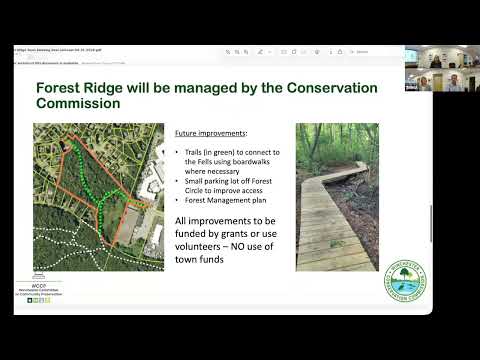
Use and stewardship: Conservation Commission Chair Tracy Olsen said the commission envisions a few low-impact trails and boardwalks to protect wetlands, funded by grants and volunteer labor. "Passive recreation is anything that doesn't involve a field with grid lines on it — so walks, picnics, birding," Olsen said, adding that formal trail plans (including whether to allow mountain biking) had not been finalized and the commission would seek input from interested communities.
Ownership, appraisal and past proposals: Presenters said the parcel is held by the Shannon family. Attendees and presenters reviewed prior development attempts: a Marino proposal (circa 2005) for a roughly 17-unit subdivision and a later Krebs proposal (circa 2015–16) that required extensive blasting and additional access. Those proposals were withdrawn after engineering and access concerns. A town meeting member questioned the $3,000,000 appraisal, noting that appraisals historically used "highest and best use" (often single-family estate value) and argued the site’s development constraints might make the appraisal high; Olsen responded that professional appraisals meeting federal and state standards have been obtained and could inform negotiation strategy with the owner.
Legal and program context: Presenters said a conservation restriction is required when CPA funds are used to buy land; the one-time legal and filing costs for that restriction were included in the motion (motion 2) as an onetime $28,500 component. The group discussed CPA allocation rules; Capadano said state law requires a minimum 10% allocation to the open-space/recreation category (of CPA funds) but local WCCP targets can be higher.
Outstanding questions and follow-up: Attendees asked about parking and walkway costs (presenters said those are not part of the acquisition request and would be grant- or volunteer-funded), potential insurance costs (no material additional insurance was expected beyond town coverage), whether the marsh feeds municipal water supply (presenters agreed to confirm this before town meeting), and whether a third party would hold the conservation restriction (presenters said the town cannot hold a restriction itself on town land and they hope an independent nonprofit — the newly formed Friends of Forest Ridge — could serve that role at no cost).
Next steps: Organizers encouraged town meeting members to post follow-up questions to the TMMA forum. Presenters reminded the audience that Article 35 will be voted at spring town meeting and noted the requirement for a two-thirds vote for some CPA-related actions; no formal vote occurred during the infocast.
The town will post the session recording and follow-up information on the TMMA forum and the WCCP said it will provide verified figures (for example, exact long-term debt-service totals) ahead of town meeting.