Get Full Government Meeting Transcripts, Videos, & Alerts Forever!
Get email alerts on the Homestead Trusts Adjacent Lots topic
No spam. Unsubscribe anytime.
Committee hears bills to restore homestead tax treatment for living trusts and adjacent lots
Summary
The House Finance Committee heard testimony on HB 52-35 and HB 52-36 to restore eligibility for the principal residence exemption and homestead property tax credit for homes held in living (revocable) trusts and for adjacent vacant lots, after a Treasury reinterpretation reduced eligibility for some retirees.
Representative Schutte and tax-aid volunteers told the House Committee on Finance on June 2 that a recent Michigan Department of Treasury reinterpretation removed longstanding tax relief for some homeowners who had placed houses in living trusts or who owned adjacent vacant lots.
At the hearing, Representative Schutte said the bills seek to reverse that change. He described HB 52-35 as a measure “to explicitly qualify homes owned by a living trust to claim the principal residence exemption and the homestead property tax credit,” and HB 52-36 to make adjacent vacant lots eligible for the same relief. He said the bills would “restore how living trusts and adjacent lots have been historically treated for tax purposes.”
Mark Maranen (introduced by Representative Schutte), testifying for the sponsors, described practical impacts on working-class retirees. He said Treasury’s revised interpretation, issued in 2024, has led some homeowners who created revocable trusts to lose eligibility for the homestead credit they had assumed would continue. He noted the difficulty of providing an exact statewide count because the tax system does not record trust status and volunteer tax-aid programs are barred from collecting that personal data: “My inbox filled up pretty quickly” after the policy change, he said.
A retired CPA volunteering with the Accounting Aid Society in Detroit added that the Michigan Association of CPAs supports both bills and that the dollar amounts for adjacent lots are small but meaningful for cities such as Detroit that encourage homeowners to consolidate or buy the lot next door.
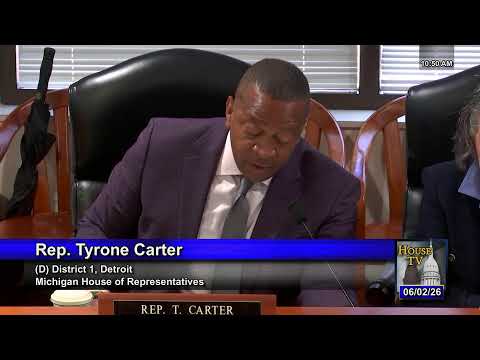
Members pressed witnesses on scope and mechanics. Representative Martin asked about urban examples and was told the bills are intended to allow adjacent, contiguous residential lots to be treated as part of a homestead. Representative Pies asked whether agricultural parcels or larger estates would be affected; witnesses answered that residential classification matters and wealthier properties are unlikely to qualify because of taxable-value limits. Representative Tyrone Carter asked about income thresholds; witnesses estimated the upper household-income limit for the homestead credit at roughly $69,000–$70,000 but said exact numbers of affected households are not available from tax records.
No committee vote on HB 52-35 or HB 52-36 occurred. The chair read written positions from groups that submitted cards, noting two Community Economic Development Association of Michigan representatives as wishing not to speak in support and a Michigan Department of Treasury representative listed as neutral.
The bills will remain pending with the committee; sponsors and witnesses said they would follow up with Treasury staff and the committee as discussions continue.