Get Full Government Meeting Transcripts, Videos, & Alerts Forever!
Get email alerts on the Appropriations Ldsi Roundup topic
No spam. Unsubscribe anytime.
Appropriations subcommittee hears more than a dozen LDSI funding requests for childcare, parks, workforce and safety
Summary
Michigan House Appropriations Subcommittee on Labor and Economic Opportunity heard a range of Local Downtown and Economic Stabilization Initiative requests, including proposals for early-childhood slots in Detroit’s Brightmoor, parks infrastructure, literacy hubs, workforce training and statewide synagogue security; the committee approved minutes but made no funding decisions on the day’s docket.
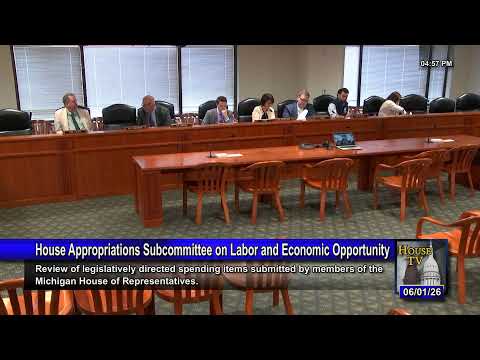
The House Appropriations Subcommittee on Labor and Economic Opportunity met to hear Local, Downtown and Economic Stabilization Initiative (LDSI) funding requests from nonprofits, municipalities and local institutions across southeast Michigan.
Presenters outlined requests ranging from capital renovations to staffing and program expansion. Representative Young introduced multiple community requests for Detroit neighborhoods, including Starfish Family Services’ plan to buy and renovate a vacant building in Brightmoor to add licensed early-childhood capacity and the Detroit Parks Coalition’s ask for $550,000 to upgrade restrooms, trails and ADA access across city parks (Eliza Howell Park was cited as a recent master‑planning example).
Brilliant Detroit asked for $3,000,000 to scale a neighborhood-based literacy hub model that its presenter said has shown strong reading gains among participating children. Workforce and education appeals included a $5,000,000 five‑year request for the Saint Vincent and Sarah Fisher Center to expand GED testing and placement programs, and a $2,000,000 one‑time request to help Cleary University transition three nursing programs from the closing Siena Heights.
Municipal requests included a sewer‑lining program pitch from the city of Berkeley, a proposed regional wellness campus and indoor athletic facility in Royal Oak, and a Sterling Heights roads/design request tied to a private Lakeside Mall redevelopment. Oakland County water officials asked for $3,000,000 for a Nelson Drain basin detention project to manage stormwater and reduce downstream combined‑sewer impacts. Public‑safety asks ranged from replacement frontline fire trucks for townships and an aerial ladder truck for Ann Arbor, to a $5.75 million, four‑year statewide proposal to underwrite security guards, training and physical hardening for synagogues and other Jewish institutions following a March attack that presenters said demonstrated the cost and life‑saving value of prior security investments.
Several health and social‑service providers asked for one‑time and multiyear appropriations to expand evidence‑based programming: Silent Cry Inc. sought funds to buy and operate a mental‑health ‘trauma bus’ to deliver mobile services; Hope Network asked for $800,000 to expand ADOS‑2 autism diagnostic training and parent‑child intervention trainer capacity; Special Olympics Michigan sought $1,000,000 to expand its Unified Champion Schools to every county.
Committee members pressed presenters on sustainability, matching funds and phasing. Presenters repeatedly cited public‑private partnerships and philanthropy as part of sustainability plans; a range of speakers said the requests would fund infrastructure or one‑time transitions rather than recurring general operations. No formal appropriation votes were recorded in the transcript. The committee approved the May 20 minutes and recessed/adjourned after the final testimony.
The subcommittee will reconvene in future appropriations process steps to consider funding decisions; presenters said many requests had additional private and federal partners and that some projects could be delivered in phases if only partial state funding is available.