Get Full Government Meeting Transcripts, Videos, & Alerts Forever!
Get email alerts on the Higher Education Budget topic
No spam. Unsubscribe anytime.
Morehead State president asks House budget panel to continue asset-preservation funding, back new buildings
Summary
Jay Morgan, president of Morehead State University, told the House Budget Review Subcommittee on Postsecondary Education the university needs continued asset-preservation funding, a minimum distribution from the performance-funding pool, and capital support for an applied science building, a space-technology facility and a cost-shared replacement of Maze Hall.
Jay Morgan, president of Morehead State University, asked the House Budget Review Subcommittee on Postsecondary Education to sustain funding that has supported campus repairs and to consider new capital investments, including an applied science building and a cost-shared replacement of Maze Hall.
Morgan told the committee Morehead State has a largely in-state student body (about 82% of the freshman class) and that roughly half of its students are low-income. He said the university has benefited from prior inflationary adjustments (about $1.7 million for his institution) and urged continued assistance paying rising fire and tornado insurance premiums and other operating pressures.
The president pressed the committee on two related budget priorities. First, he asked the panel to preserve or restore the state's asset-preservation funding for universities; Morehead State has received roughly $18 million per year from the biennial asset-preservation pool in the current budget cycle and Morgan said those funds have paid for roofs, HVAC replacements and other deferred maintenance. "Those have been much-needed funds," he said.
Second, Morgan called for a change to how performance-funding dollars are distributed. He said the Kentucky Council on Postsecondary Education administers a roughly $115 million performance-funding bucket and that Morehead State has received "hardly any funds" under the formula for about nine years. "If there were funds added to that, CPE is requesting that there be a minimum distribution where every university gets at least some money," Morgan said, adding that the university would alternatively support a dedicated line-item appropriation to address the shortfall.
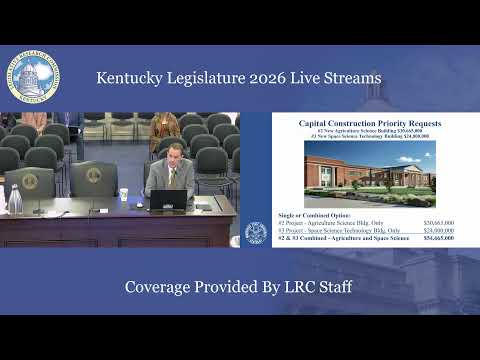
On capital construction, Morgan identified a new applied science building as the university's top request, proposing it consolidate and replace one larger and possibly one smaller building to house programs including agriculture, information/computer technology, construction management, land surveying and psychology. He described the space-science program as a separate, research-driven success: Morehead runs bachelor's and master's programs and this fall will begin a doctorate in engineering in space science, with about 250 students tied into R&D contracts and partnerships with agencies and private contractors.
Morgan also proposed a cost-share replacement of Maze Hall, an on-campus residence hall built in the 1930s. He described the project as roughly $20 million and asked the General Assembly to consider $10 million in state or bond funds while the university would match the remainder.
The presentation also highlighted the Craft Academy, a residential program for academically gifted 11th and 12th graders. Morgan said the 2025'26 appropriation of $5.44 million currently supports about 200 students; he asked the subcommittee to consider a funding increase to expand enrollment by about 20 students.
Representative Tipton asked whether the university had pursued public'private partnerships for residence halls. Morgan said Morehead evaluated P3 options six to seven years ago but prefers to retain ownership of housing to control student pricing and manage operational risk; he cited the advantages of owning housing during the COVID response. Tipton also questioned interest in land-surveying coursework and the space-science program; Morgan described steady student interest in surveying courses and said the space program has attracted employers and research dollars to the region.
The committee approved minutes from its previous meeting by voice vote (mover and seconder not recorded in the transcript). Chair Riley said the subcommittee will continue meetings with postsecondary groups over the next several weeks to develop recommendations and next steps.
The record shows requests for continued asset-preservation funding, a minimum distribution from the state performance-funding pool, support for several new or replacement buildings, and an expansion of the Craft Academy; the committee did not take formal votes on the capital requests during this session.