Get Full Government Meeting Transcripts, Videos, & Alerts Forever!
Get email alerts on the Tourist Rooming House Ordinance topic
No spam. Unsubscribe anytime.
Sawyer County committee forwards revised short-term rental ordinance to County Board without recommendation
Summary
After public comment and staff presentations, the Health & Human Services committee voted to send a revised tourist rooming-house ordinance to the full County Board without a committee recommendation; the draft tightens neighbor notification, adjusts occupancy rules and lowers the calls-for-service threshold that can trigger enforcement.
A majority of the Sawyer County Health & Human Services committee voted to forward a revised tourist rooming-house ordinance to the full County Board without a committee recommendation after a public hearing that included residents and data presentations.
The ordinance draft, summarized by county staff, trims and simplifies existing language and focuses on enforceable sections. "Our overall goal was to shorten the ordinance and simplify things," the presenter said, describing edits to definitions, application requirements, owner/agent responsibilities, neighbor notification and enforcement language.
Key changes staff identified include: a consolidated County Health Officer definition; streamlined application requirements to align the county licensing step with the state process; a new renewal requirement that owners or owners' agents notify neighboring properties within 300 feet of the rental perimeter; and an adjusted occupancy standard of "two people per bedroom plus two per facility," intended as a local compromise from the state's stricter two-per-bedroom standard.
The draft added local provisions not fully addressed by state code, including recreational-burning setbacks for campfires, waste and recycling requirements tailored to local conditions, and guidance to secure properties against wildlife such as bears and raccoons.
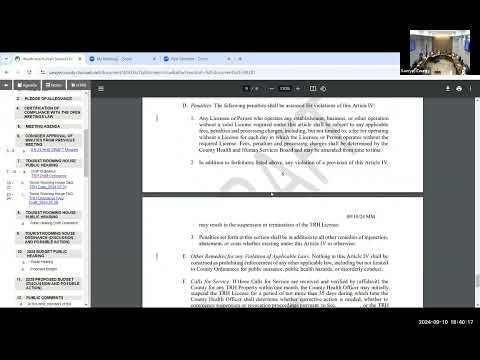
Staff also tightened enforcement language. Where the previous draft used a five-calls-per-year threshold for enforcement review, the new version states that "more than three phone calls within three months" could trigger consideration of license revocation proceedings, a change staff described as responsive to resident complaints.
Residents at the public hearing offered mixed views. Jenny Chabak, who identified herself as a local property owner, praised the committee process and urged the board to move the draft forward, saying it recognized Sawyer County's seasonal tourism patterns and aimed "to protect our natural resources, our limited resources both natural and infrastructure." Douglas Kurts, a commenter, urged caution and asked for more granular data on unit counts and ownership, warning that vague enforcement or unclear affidavit procedures could make the ordinance ineffective in practice.
Legal counsel and staff clarified jurisdictional choices: the county is implementing a public-health ordinance (not a zoning ordinance) so the county can overlay local licensing and enforcement on inspections already performed by county public-health staff acting as agents of the state. Counsel told the committee that choosing zoning would have required conditional-use permits for hundreds of properties and a substantially larger workload for zoning staff.
After discussion the committee first voted on a motion to send the ordinance to the County Board with a recommendation for approval; that motion failed on roll call. A subsequent motion to forward the ordinance to the County Board without a committee recommendation passed; staff confirmed the item will be on the County Board agenda next week.
The committee and members of the public pushed repeatedly for clearer enforcement protocols, including timing of revocation, appeal windows and the operational thresholds that would count as "calls for service" or produce sanction ticks. Staff said those procedures will be developed as policies and protocols if the ordinance proceeds.
The committee did not adopt final fees or some implementation details at the meeting; staff said permit fees would be set later to reflect actual administrative workload if the County Board approves the ordinance.
The committee's vote moves the ordinance forward to the full Sawyer County Board for deliberation and potential adoption.