Get Full Government Meeting Transcripts, Videos, & Alerts Forever!
Get email alerts on the Airport Master Plan topic
No spam. Unsubscribe anytime.
Sawyer County committee forwards airport master-plan preferred alternative after public questions on noise, wetlands and property
Summary
Consultants presented a draft Sawyer County Airport master plan recommending a runway shift and future 6,000-foot runway; residents raised concerns about noise, wetlands, and property acquisition. The Public Works Committee voted to forward the preferred alternative to the County Board for final action.
At a public information session of the Sawyer County Public Works Committee, consultants presented a draft master plan for Sawyer County Airport and the committee voted to forward the recommended development alternative to the full County Board for consideration.
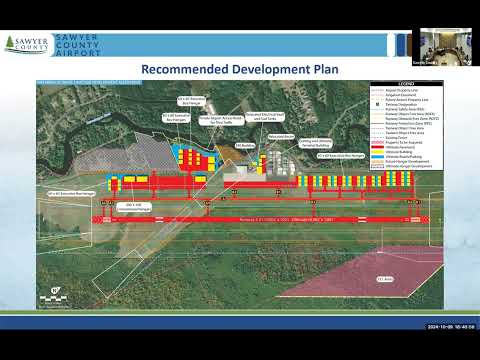
Mike deimy turko, identifying himself as "the President of coffin Associates," led the presentation and said the plan is a draft that will be finalized only after County Board review. He said the master-plan process—required by the Federal Aviation Administration for airports that receive federal grants—focuses on forecasting aviation demand and producing an Airport Layout Plan that supports federal funding requests. "We believe that the runway should be lengthened to about 6,000 ft," he told the committee and the public, and described shifting the runway roughly 1,000 feet north and about 400 feet east while reusing the existing runway pavement as a parallel taxiway.
The consultants presented forecasted activity (29 based aircraft today, projected to about 41 over 20 years, and two based business jets projected to rise to about five) and warned of a regulatory threshold: a grouping of aircraft that reaches 500 annual operations triggers more stringent FAA design requirements. The consultants said the airport's operations counts—captured from FAA sources and ADS‑B/radar feeds—are a minimum baseline and may undercount some flights.
Consultants also discussed environmental constraints. They showed existing wetlands on the proposed development footprint and described noise-mapping using DNL contours. The team said the 65 DNL contour—the commonly used threshold for noise mitigation—remains concentrated close to the runway and largely inside airport property, though they warned that any large improvements near wetlands or the river would likely require environmental studies and coordination with agencies such as the Wisconsin Department of Natural Resources and federal resource agencies.
Residents used the public-comment period to press the county on noise, operations and land-ownership limits. An unnamed resident who gave an address on North Maria Lane asked why planes sometimes operate in the pre-dawn hours and whether that activity depresses property values; the consultant replied that airports with federal grant assurances operate 24 hours and that noise-modeling (not single events) determines whether mitigation is warranted. Resident Nancy Shrier asked for the specific federal law giving the FAA leverage; Carl keer of Becker Hoy Associates pointed attendees toward Title 49 U.S.C. subtitle 7 and the FAA Grant Assurances, and read an excerpt of "Grant Assurance 21," which addresses compatible land use.
Several neighbors and property owners urged the county to avoid developing the nine-acre parcel nearest Namakagan Lane, to protect the adjacent river corridor and to pursue comprehensive environmental review for any project that would affect wetlands or river buffers. Property owner Devin Weaver said his parcel is currently zoned industrial and said he would consider selling if a willing-seller transaction were negotiated at fair market value.
After public input, the committee discussed next steps for the Airport Layout Plan and the capital improvement plan required to make projects eligible for federal grants. With three committee members present and two absent, members debated whether to defer; Randy Newman made a motion, seconded by Brian Binet, to forward the preferred alternative and associated materials to the County Board. The motion passed on a voice vote; the County Board meeting was scheduled the following week.
What happens next: the consultant will use the committee's preferred alternative to prepare the technical Airport Layout Plan and a draft capital-improvement plan for County Board review. Any individual project (runway, taxiway, hangar development, road relocation or closure) that moves beyond planning will trigger additional environmental review and public involvement per federal and state requirements.
Sources and attribution: quotes and policy citations are drawn from the session presentation and public-comment exchange at the Sawyer County Public Works Committee public information session on the airport master plan. The committee forwarded the preferred alternative to the County Board by motion (Randy Newman, mover; Brian Binet, second).