Get Full Government Meeting Transcripts, Videos, & Alerts Forever!
Get email alerts on the Anti Poverty Chip topic
No spam. Unsubscribe anytime.
Douglas County partners present 94 lived-experience stories to inform anti-poverty plan
Summary
County staff and partners presented findings from “Douglas County Thrives,” a KU CPBR-backed project that gathered 94 stories from ALICE and low-income households, identifying income instability, housing and food insecurity, and structural eligibility barriers and recommending coordinated local actions.
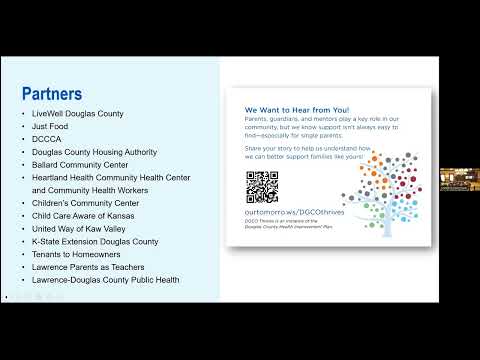
Douglas County staff and community partners on Tuesday presented findings from “Douglas County Thrives,” a community-sensemaking project that collected 94 first-person stories from households the project identifies as ALICE (asset-limited, income-constrained, employed) to inform the county’s anti-poverty Community Health Improvement Plan.
The presentation, led by Jenny Welch Buller of the University of Kansas Center for Public Partnerships and Research, explained that the project used an open story prompt and participant self-coding to surface lived-experience themes. Partners recruited respondents through community events and service locations, offered the survey in English and Spanish, and compensated participants with grant-funded gift cards. The project was supported by a $25,000 International City/County Management Association (ICMA) economic mobility cohort grant.
Why it matters: presenters and partners said the qualitative data gives county officials and service providers concrete, narrative evidence of gaps that routine datasets may miss — and that those narratives point to local policy and program levers to reduce harm and improve access.
Key findings: presenters reported that about 40% of respondents identified as single parents and 72% identified as female. Respondents reported household incomes under about $75,000; over a third reported household incomes below $10,000, and more than half reported earning less than $30,000. The team named unemployment, mental-health challenges and food insecurity among the top problems cited; housing instability, transportation barriers and substance-use disorder also appeared frequently. Presenters noted a recurring theme of stigma when families sought help and described the “benefit-cliff” effect, where small income gains can lead to loss of supports before stability is achieved.
Partners’ recommendations: community sensemaking sessions generated a set of action ideas partners urged the county and local organizations to consider: increase income stability through direct-assistance programs and cost-burden reduction; simplify access with no-wrong-door approaches and streamlined eligibility; strengthen service coordination and whole-family designs; expand credit counseling; and intentionally elevate lived experts and peer supports when designing services.
Implementation and next steps: KU CPBR and partners said they will link the qualitative findings to existing CHIP workgroups and other local initiatives. Presenters urged that the 94 stories be revisited across initiatives for continued insight and that local convenors — currently United Way of Call Valley, Heartland Community Health Center and Lawrence–Douglas County Public Health — expand coordination to reduce duplication and 'doors' that require repeated applications.
County data cited: presenters reported that nearly 31,000 Douglas County households fall under the ALICE threshold and that 16% are under the federal poverty level; presenters used those figures to frame local opportunity for policy changes that do not rely on federal reform.
Voices from partners: a DECA representative described working with women in residential programs and said their organization provides money-management courses and intends to add credit counseling in transitional housing work. United Way and LiveWell representatives discussed a community resource-navigation model and potential reimbursement strategies (Z-codes) to diversify revenue and scale navigator roles.
Commissioner questions and follow-up: commissioners pressed partners on which organizations should be at the table to enact changes and whether solutions require local policy adjustments or state/federal advocacy. Presenters and partners said both are relevant, but emphasized local system and contractual policy changes (‘‘small‑p’’ policy) and coordinated care plans as immediate, actionable steps.
The meeting recessed to the 5:30 business session after closing remarks thanking partners and participants.