Get Full Government Meeting Transcripts, Videos, & Alerts Forever!
Get email alerts on the Flexible Housing Pool topic
No spam. Unsubscribe anytime.
Douglas County officials say flexible housing program tied to sharp fall in emergency contacts for participants
Summary
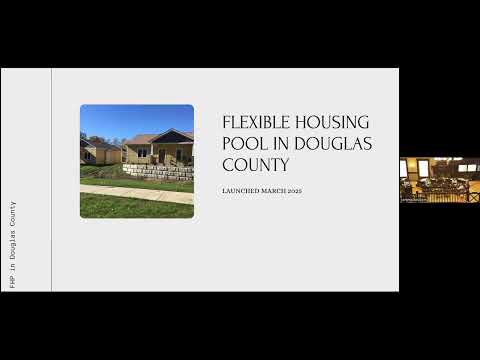
County staff and partners told commissioners the Flexible Housing Pool, launched in March 2025, has housed 18 of 24 participants and early cohort data show a 59% reduction in emergency contacts for a 10-client subcohort; commissioners asked for per-client cost and ambulance-cost details to refine ROI estimates.
Douglas County staff and community partners briefed the Board of County Commissioners on June 3 about the county's Flexible Housing Pool (FHP), saying early results show the program is reducing emergency system use among high-needs participants.
Kristen, the staff presenter, told commissioners the FHP was created to fill gaps in permanent supportive housing for people who do not qualify for HUD-funded programs and that the county launched its local FHP in March 2025. She said the county provides funding and coordination, the housing authority provides vouchers and program structure, and Mental Health America of the Heartland provides support and housing stabilization. "Flexible housing pools fill the gap that PSH cannot fill because HUD is slow and rigid," she said, describing FHP's mix of flexible rental subsidies and dedicated support services.
County data analyst Ani Nula presented a cohort analysis showing 24 program participants in the dataset, 18 of whom are currently housed with placement dates from March 2024 through May 2026. Nula said FHP participants are older and have more disabilities than the broader homeless population and are higher utilizers of emergency services. For a 10-client subcohort with at least nine months of post-housing data, she reported "an overall reduction of 59% in emergency contacts," with ambulance and emergency department contacts showing the clearest declines.
Staff framed those service reductions as both human and fiscal outcomes. Kristen and partner agencies said housing stability, coordinated casework and "support team" meetings that share tasks among agencies have reduced duplicated work and opened capacity across providers. Monica Casares, a service coordinator on the program, described success as clients "reintegrat[ing] with their families, with their communities, finding new friends, like hobbies ' more than just survival."
Commissioners pressed staff for more precise cost metrics. Ani said she had identified counts of EMS and ambulance usage for participants but had not yet obtained updated ambulance cost figures from the fire department. County staff acknowledged program-level budgeting is currently structured as $28,781 per household for the funded 32-household line in the budget and agreed to return with per-client-per-month costs and updated EMS/ambulance cost estimates to support a fuller return-on-investment analysis.
Presenters also discussed operational details and limits of the FHP model. Kristen explained master leases as an agency-held lease option when landlords will not accept a tenant directly; vouchers remain preferred as they build rental history. Gal from the Lawrence-Douglas County Housing Authority clarified LDCHA's current requirement for three years of residency (not strictly rental history) and said the authority is exploring dropping that requirement to two years to align with transitional programs. Staff emphasized that a small subset of clients have care needs beyond local community capacity (for example, continuous skilled nursing), which may require different care pathways and coordination with Medicaid or regional providers.
The presentation ended with next steps: staff will add ambulance cost data and per-client cost-per-month estimates, continue to enlarge landlord engagement, track employment and vocational outcomes more consistently, and develop an online dashboard to display program metrics and outcomes over time. The board recessed to its 5:30 p.m. business meeting after the discussion.