Get Full Government Meeting Transcripts, Videos, & Alerts Forever!
Get email alerts on the Education Literacy topic
No spam. Unsubscribe anytime.
Cajon Valley Union board hears LCAP updates; district rolls out K–2 reading screener
Summary
District staff outlined practices to create safer learning environments and detailed implementation of a new K–2 reading screener, including an October pilot at Avocado Elementary, parent opt-out notices and a robust teacher training plan.
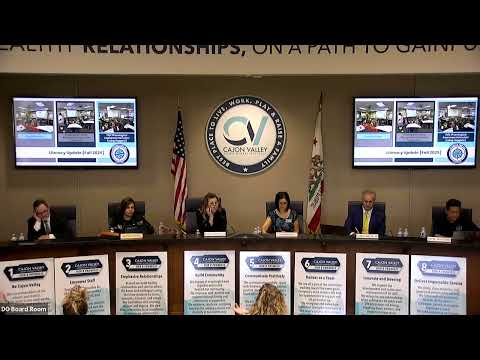
Cajon Valley Union School District officials on Sept. 9 updated trustees on Local Control and Accountability Plan work to strengthen classroom environments and expand early-literacy screening.
At the meeting, Jeremy Berner, director of educational services, described site-level routines and evidence-based classroom practices that the district is emphasizing to ‘‘set our learning environments up for academic success,’’ pointing to visual schedules, shared classroom agreements and standard operating procedures as examples of practices one expects to see across sites.
Bethany Schwabek, who led the literacy presentation, outlined the district’s rollout of a K–2 reading screener the board recommended for adoption last year. She said the screener ‘‘is meant for early identification. It’s important even at the earliest stages—we can see if a student is struggling with sounds’’ and stressed that ‘‘this is not a diagnosis’’ but an additional data point to help target interventions earlier.
Schwabek described the family notification plan: an initial letter has gone to families, an email with details and opt‑out information will be sent 15 days before screening, teachers will administer one‑on‑one screeners that take about 10 minutes per student, and parents will receive results within 45 days. The literacy team plans an October pilot at Avocado Elementary to refine training and procedures before broader implementation.
Staff outlined a three-step professional learning model for teachers—what screening is, how to administer it, and how to use the data with families and interventions. Schwabek said the district offered release time for teacher training; of 103 teachers who began training, about 96 (roughly 93 percent) elected to pursue full certification in the program.
The district emphasized the screener’s preventive intent: staff described it as one ingredient among many assessments that together build a student’s ‘‘literacy story’’ and said it will be used to accelerate early supports in general education, not to assign special-education diagnoses.
Trustees did not take any formal action on the screener at the meeting; staff said they will return with additional metric reports in October and more detailed implementation data as the pilot proceeds.
What's next: staff will pilot the screener in October, complete site-level training, and report back to the board with implementation feedback and updated data.