Get Full Government Meeting Transcripts, Videos, & Alerts Forever!
Get email alerts on the Education Supports topic
No spam. Unsubscribe anytime.
District outlines 'comprehensive student support' plan and early home‑visit results
Summary
District directors presented a rollout of a coordinated student support team model (LCAP Goal 2) and family‑engagement practices, reporting early positive signals from site pilots and plans to collect formal learning and discipline data by trimester end.
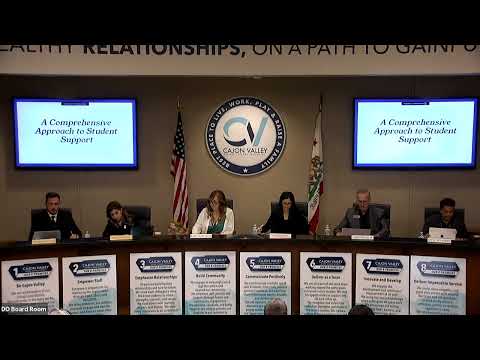
District directors Justin Grich and Jeremy Burner on Oct. 7 presented the Cajon Valley Union Governing Board with a planned, coordinated approach to student supports under LCAP Goal 2, describing the district’s effort to make behavioral, academic and attendance supports more consistent and timely across sites.
Justin Grich, director in educational services, described the "Goldilocks dilemma" — cases where supports are sometimes too little, sometimes too many, and sometimes just right — and said the district is building systems so the right staff can do the right work at the right time for students. "We want a systematic, timely, supportive approach where the right people are doing the right work at the right time," Grich said.
Jeremy Burner detailed the initial rollout across five traditional middle schools and several large elementary sites, summarizing listening sessions, job‑description reviews and site prototyping carried out in August and early fall. Burner said the district is iterating on the model (v1.0 now, expected v1.4 by the end of the year, with a v2.0 next year) and conducting structured site visits to collect feedback.
Board members asked about measurable learning outcomes. Staff said they are collecting referral and discipline data (including suspension) as well as in‑class measures and expect preliminary data at the end of the trimester; presenters agreed to include those midyear results in LCAP reporting to the board. One board member asked whether the model changes teacher responsibilities; presenters said it clarifies who teachers should contact for student supports without adding or removing teacher duties.
Presenters also described family engagement practices tied to the model, including summer home visits and family‑teacher teams (designed to build relational trust and provide one clear academic goal for families). The presenters reported that home visits — 496 site‑funded this year versus 555 grant‑funded last year — correlated with improved attendance and higher belonging scores on spring family surveys.
Board members encouraged staff to continue data collection and to present the findings formally in midyear LCAP reporting.