Get Full Government Meeting Transcripts, Videos, & Alerts Forever!
Get email alerts on the Nature Based Strategies topic
No spam. Unsubscribe anytime.
LUPC webinar spotlights nature-based strategies, living shorelines and retreat as tools for coastal resilience
Summary
A Land Use Planning Commission webinar gathered coastal scientists and agency staff to outline nature-based strategies — from living shorelines and culvert replacements to buyouts and retreat — and to share networks, case studies and proposed regulatory changes to encourage plant-based stabilization.
The Land Use Planning Commission convened a webinar on nature-based strategies for hazard resilience, where presenters described techniques ranging from vegetated buffers and bioswales to living shorelines and managed retreat. Helena Tackenhorst, coastal program manager at The Nature Conservancy in Maine, said nature-based solutions “use nature to bring benefits to both people and nature” and framed them as often more cost-effective over time than hardened structures.
Speakers emphasized that nature-based strategies work at multiple scales. Moderator Rachel opened the session by urging planners to consider both site-level projects and regionwide coordination. Nathan, a climate change specialist at the Maine Department of Environmental Protection, described the RSHORE approach as a whole-site assessment from upland to water that helps identify the true sources of erosion and appropriate solutions.
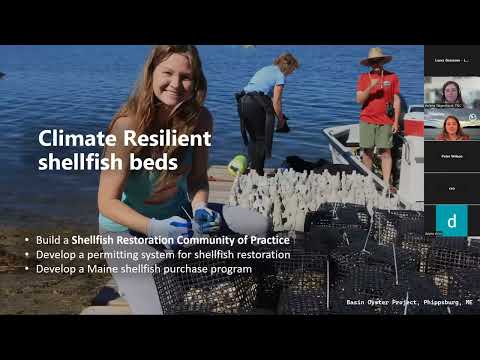
Presenters described active networks and pilots: Tackenhorst said the Maine tidal marsh restoration network has grown to more than 100 partners and that a Maine blue carbon network will host webinars and a symposium to inform policy work. She highlighted shellfish restoration as a priority but said Maine currently lacks a dedicated restoration permit for shellfish, a barrier the Basin Oyster Project circumvented using an aquaculture permit. Tackenhorst noted a pilot purchase of 20,000 oysters to seed a restoration site.
Case studies illustrated different approaches. Coastal engineer Bobby described the Coastwise guidance for road crossings and undersized culverts — a 112-page, living document intended to guide project development and monitoring — and said, “Coastwise is a team effort.” Keith Savinsky presented five living-shoreline case studies from Maine, including a sacrificial frontal dune using dredged sands, a low-cost Christmas-tree dune rebuild at Popham Beach, and a large bluff restoration on the Blue Hill Peninsula that combined regrading, logs and marsh restoration.
Speakers also reviewed tradeoffs of hard infrastructure: riprap and seawalls can protect property but often exacerbate toe scouring and loss of intertidal habitat, Nathan said, while hybrid or vegetated designs can provide resilience and habitat benefits. The DEP presenter said the agency has proposed revisions to regulations intended to encourage living-shoreline practices and to streamline some permit-by-rule pathways.
The webinar closed with a presentation from Jessica Brunicini, director of the coastal training program at the Wells National Estuarine Research Reserve, on retreat and buyouts as resilience tools. Brunicini described managed retreat as “a strategic, long-term approach” and explained buyouts as typically voluntary, federally funded acquisitions that require returning the land to open space in perpetuity; she cited examples where municipalities have planned or voted to relocate critical infrastructure.
Organizers said slides, a recording and contact lists will be shared to help communities follow up. The session included a chat Q&A on permitting, volunteer opportunities and funding pathways; presenters directed participants to networks and DEP resources for further technical help.